Denon AVR-X2700H 8K Ultra HD 7.2 Channel Review
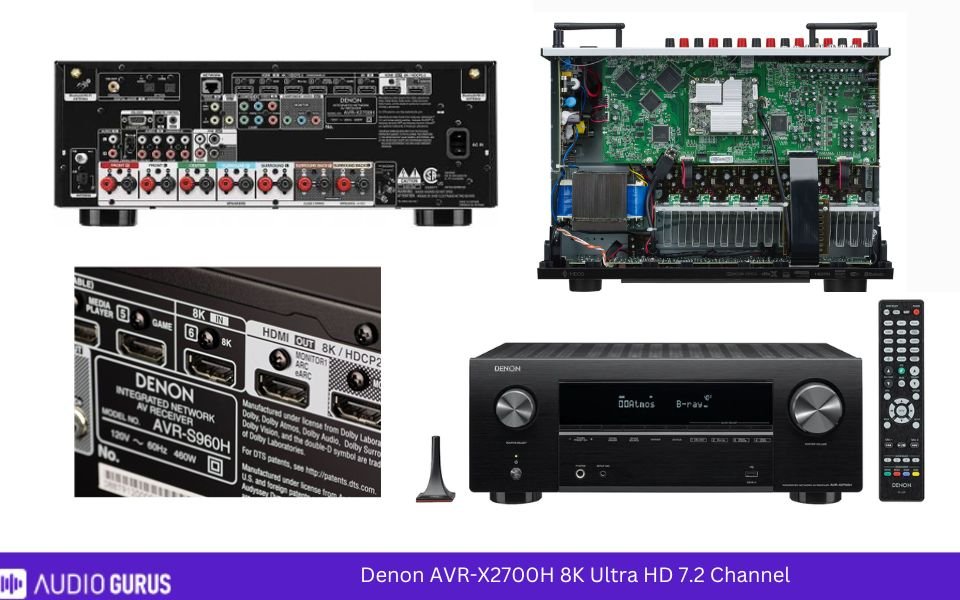
Home theatre fans who seek future-proof gear without going crazy will love the Denon AVR-X2700H. This receiver is great for movie evenings and detailed music playing. It excels in Dolby Atmos and 8K passthrough in medium to big spaces. If you have several devices to connect, this system may be ideal for building or upgrading your entertainment setup.
Our Verdict
In conclusion, the AVR-X2700H excels in sound, connectivity, and future-proof features like 8K passthrough. It's best for bigger spaces, but setup may be difficult and may overwhelm beginners. Its media clarity is remarkable despite its weak bass. Suitable for serious home audio enthusiasts but overkill for smaller areas or simpler demands.
PROS
- Great sound clarity.
- Future-proof with 8K support.
- Dolby Atmos immersive audio.
- Plenty of HDMI inputs.
- Strong wireless connectivity.
- Smooth 4K HDR playback.
- Automatic room calibration.
- Ideal for medium-large rooms.
CONS
- Setup can be tricky.
- Lacks deep bass power.
- Bulky design, space-consuming.
GENERAL
| Receiver Type | A/V Receiver |
|---|---|
| Number Of Channel | 7.2 Channel |
| Number Channel Processing | 7 |
| Audio Feature | Dolby Atmos , DTS:X , Front Wide Ch. |
| Video Feature | HDR10 , HDR10+ , Dolby Vision , HDCP 2.3 , 4K Passthrough , 8K Passthrough , 4K Upscaling |
| Watts Per Channel | 95 watts |
| Zones | 2 |
| Radio | Internet Radio , Pandora , Spotify , Tidal , Deezer , Napster , SiriusXM |
| Amplifier | Class A/B |
CONNECTIVITY
| Ethernet | Yes |
|---|---|
| Wi-Fi | Yes |
| Bluetooth | Yes |
| USB | Yes |
| RCA LIne Input: | 4 |
| RCA LIne Output: | No |
| RCA Pre-Outs: | 0.2 |
| XLR Line Inputs: | No |
| XLR Pre-Outs: | No |
| Phono Input: | Yes |
| Optical Inputs: | None |
| Optical Output: | None |
| Coaxial Inputs: | None |
| Multi-Channel Input: | None |
| Headphone Out: | Yes |
| HDMI Inputs: | 6 |
| HDMI Outputs: | 2 |
| 8K Inputs: | Yes |
| Composite Video Input | 2 |
| Composite Video Output: | 1 |
| Component Video Input: | 2 |
| Component Video Output: | 1 |
| Front A/V Inputs: | None |
| Speaker A/B: | None |
AUDIO FEATURES:
| Maximum Channel Processing | 7.2 channels |
|---|---|
| Dolby Atmos | Yes |
| Dolby Atmos Height Virtualization | Yes |
| Dolby Atmos Music | Yes |
| Dolby TrueHD | Yes |
| Dolby Digital Plus | Yes |
| Dolby Surround Upmixer | Yes |
| Dolby Pro Logic | N/A |
| Dolby Digital EX | Yes |
| Surround EX | Yes |
| DTS:X | Yes |
| DTS Neural:X | Yes |
| DTS Virtual:X | Yes |
| DTS Neo | N/A |
| DTS-HD Master Audio | Yes |
| DTS-HD High Resolution Audio | Yes |
| DTS 96/24 | Yes |
| DTS Express | Yes |
| DTS-ES | Yes |
| IMAX Enhanced | N/A |
| PCM | Yes |
| Music Playback via USB | Yes |
| High Resolution Music Playback via USB and/or Network | Yes |
| High Resolution Audio Formats via USB | Yes |
| Gapless Playback | Yes |
| DSD via HDMI | Yes |
| DSD via USB | Yes |
| DSD to PCM Converter | Yes |
| USB DAC | N/A |
| Jitter Reduction | Yes |
| DTS Dialog Control | Yes |
| Dialog Enhancement | Yes |
| Dialog Level Adjustment | Yes |
| Dialog Normalization | Yes |
| Dialogue Lift | Yes |
| Compressed Music Enhancer | Yes |
| High-resolution Music Enhancer | Yes |
| Audyssey Dynamic EQ | Yes |
| Audyssey Dynamic Volume | Yes |
| Audyssey LFC | Yes |
| Audyssey Sub EQ HT | Yes |
| Audyssey DSX | N/A |
| Direct Mode | Yes |
| Pure Direct Mode | Yes |
| Independent Subwoofer Outputs | Yes |
| Auto Speaker Calibration System with Mic. | YPAO |
| Audyssey App Support | Yes |
| Bass Sync | Yes |
| Optimized Bass Redirection | Yes |
VIDEO FEATURES:
| HDMI Version | 2.1 |
|---|---|
| Enhanced ARC | Yes |
| HDCP Version | 2.3 |
| HDR10+ | Yes |
| Dynamic HDR | Yes |
| Dolby Vision | Yes |
| HLG (Hybrid Log Gamma) | Yes |
| QMS (Quick Media Switching) | N/A |
| 3-D Ready | Yes |
| Video Signal Passthrough | Yes |
| Video Signal Upscaling | Yes |
| Analog To HDMI Upconversion | Yes |
| Component Video Upscaling | N/A |
| isf Certified Calibration Control | Yes |
AMPLIFIERS
| Channels | 7.2 channels |
|---|---|
| Front Wide Channel Support | N/A |
| Current Feedback Topology | N/A |
| Discrete Amplification | Yes |
| HDAM | N/A |
| THX™ Certification | N/A |
| Continuous 6 Ω Rated | Yes |
| Certified 4 Ω Performance | N/A |
| Bi-amp Capability | Yes |
GAMING FEATURES
| Auto Low Latency Mode (ALLM) | Yes |
|---|---|
| Variable Refresh Rate (VRR) | Yes |
| Quick Frame Transport (QFT) | N/A |
ZONES
| Zones | 2 |
|---|---|
| Powered Zones | Zone 2 |
| Zone 2 Outs | RCA pre-outs |
| Zone 3 Outs | No |
| RS-232C Interface | Yes |
| +12V Trigger Output | Yes |
RADIO
| Analog Tuner | Yes |
|---|---|
| Digital Radio | N/A |
| Internet Radio | Yes |
| Pandora | Yes |
| Spotify | Yes |
| Tidal | Yes |
| Deezer | Yes |
| SiriusXM Internet Radio | Yes |
| Napster | Yes |
ADDITIONAL FEATURES
| On-Screen Display | Yes |
|---|---|
| GUI Languages | 5 |
| Web Browser Control | Yes |
| IP Control for CI | Yes |
| Control4 SDDP | Yes |
| PreAmp Mode | Yes |
| Display | Yes |
| Remote Controller | |
| Remote Control In/Out | 1/1 |
| LCD Display | N/A |
| Detachable Power Cord | Yes |
| Setup Assistant | Yes |
POWER
| Power Output (6 Ω, 1 kHz, 2 | 150 W |
|---|---|
| Rated Power Output (6 Ω, 1 kHz, 1 channel driven, IEC) | 150 W |
| Dynamic Power per Channel (3 Ω, Front) | 175 W |
| Dynamic Power per Channel (4 Ω, Front) | 120 W |
| Dynamic Power per Channel (8 Ω, Front) | 95 W |
| Power Output (8 Ω, 20 Hz - 20 kHz, 2 | 95 W |
| Maximum Effective Power Output (6 Ω, 1 kHz, 1 channel driven, JEITA) | 185 W |
| Power Supply | AC 230 V, 50/60 Hz |
| Toroidal Transformer | N/A |
| Power Consumption | 500 W |
| No Sound Power | 40 W |
| Standby Power | 0.1 W |
BUILD
| Dimensions (W x H x D) | 434 x 167 x 340 mm |
|---|---|
| Weight | 8.4 kg |
| Chassis | Metal |
| Front Panel | Aluminum |
| Speaker Terminals | Yes |
| Large Speaker Terminals | Yes |
| Color-Coded Speaker Terminals | Yes |
| Transparent High-Grade Speaker Terminals | N/A |
| High Grade Audio Components | Yes |
| ECO Mode / Hybrid Standby Function | Yes |
| Auto Power off | Yes |
| Warranty | 2 years |
SPECIFICATIONS
| THD digital | 0.08% |
|---|---|
| Analog Distortion | 0.08% |
| Phono Distortion | 0.1% |
| Input Sensitivity and Impedance (Line) | 200 mV / 47 kΩ |
| Input Sensitivity and Impedance (Phono MM) | 2.5 mV / 47 kΩ |
| Rated Lineout Level and Impedance | 1.0 V / 1 kΩ |
| Rated Output digital | 2.0 V |
| S/N Ratio (Line, IHF-A) | 100 dB |
| S/N Ratio (Phono MM, IHF-A) | 85 dB |
| S/N Ratio (digital) | 105 dB |
| Phono RIAA Deviation | ±0.5 dB (20 Hz - 20 kHz) |
| Frequency Response (Analog In) | 10 Hz - 100 kHz ±1 dB |
| DSD Sampling Rates via HDMI | Up to DSD 5.6 MHz |
| DSD Sampling Rates via USB | Up to DSD 5.6 MHz |
| Video Input Sensitivity/Output Level and Impedance | 1.0 Vp-p / 75 Ω |
| Video Frequency Response | 10 Hz - 100 MHz |
| Ethernet Standard | IEEE 802.3 |
| Wi-Fi Standard | IEEE 802.11 a/b/g/n |
| Wi-Fi Terminal Frequency | 2.4 GHz / 5 GHz |
| Bluetooth Version | 4.2 |
| Bluetooth Frequency | 2.4 GHz |
| USB Terminal | USB-A |
| FM Frequency | 87.5 - 108.0 MHz |
| FM 50 dB Quiet Sensitivity (IHF, 1 kHz, 100% MOD.) | 1.2 µV |
| FM S/N Ratio | 80 dB |
| FM Harmonic Distortion (IHF, 1 kHz) | 0.1% |
| AM Effective Sensitivity | 300 µV/m |
| AM Frequency | 530 - 1,710 kHz |
Design
In appearance, the AVR-X2700H has a traditional receiver design with a black, boxy appearance that blends in. It blends into your entertainment center without winning beauty competitions. The front panel features a big right volume knob and a smaller left input selector knob. Clear input and volume displays are in the center.
Though basic and effective, the buttons seem cheap. Not the most pleasurable to press, they might make the experience seem less expensive than the pricing promises. The receiver's size matters too. It's not little, so if your TV stand is tight, you may have to change things to fit.
After setting it up, you ignore these little inconveniences. The overall style works nicely for something that won't be the focal point of your living space. If you want a more current or polished style, it may disappoint.
Connectivity
In terms of connectivity, the AVR-X2700H begins to shine. It has six HDMI inputs, plenty for most people. This receiver may support a gaming console, streaming box, Blu-ray player, or all of the above. With more 8K videos coming out, its 8K passthrough makes it future-ready. It's wonderful that this receiver can handle the future, even while 4K is still king.
Another huge benefit is eARC, which lets you transport uncompressed audio from your TV to the receiver. Experience high-quality sound without sacrifices with eARC, eliminating frustration from Dolby Atmos or DTS.
The wireless connection is good too. Built-in Wi-Fi and Bluetooth make Spotify, Tidal, and YouTube Music streaming easy. I streamed from iOS and Android smartphones without issues. Apple customers also benefit from AirPlay 2, which makes sending music and podcasts easy.
Wireless connection setup isn't intuitive. For non-techies, it may take time to get things functioning. After setup, it's largely set-and-forget. The AVR-X2700H supports most audio formats, but not DTS Pro, which may be a concern for high-end audio systems. For most people, this won't matter, but audiophiles may notice.
Performance
When it comes to performance, the AVR-X2700H does a great job for both movies and music. I set it up in a 5.1.2 Dolby Atmos configuration, and the experience was pretty immersive. Action scenes in movies really come to life, with sounds moving around the room and even overhead. Dialogue is clear, and even when things get loud, the receiver handles everything without missing a beat.
It’s equally capable when it comes to music. I threw a wide range of genres at it—everything from jazz to hip hop—and the receiver didn’t disappoint. The low end is punchy, which is great for bass-heavy music, while the mids and highs stay crisp. You can push the volume pretty high without distortion, which is always a plus if you like cranking up the tunes.
That said, if you’re expecting deep, wall-shaking bass for things like dubstep or cinematic explosions, you might feel it’s a bit lacking. The AVR-X2700H delivers clean sound, but it doesn’t have the overwhelming power of higher-end models that really shake the walls with low-end frequencies. It’s more than enough for most home setups, but if you’re a bass enthusiast, you might want to look at adding a more powerful subwoofer or even consider a more robust receiver.
For movies and TV shows, the AVR-X2700H handles surround sound really well. Even smaller sound details, like footsteps or rain, are distinct and spread across the room in a way that pulls you into the scene. It’s ideal for home theaters, especially in medium to large living rooms. However, it’s probably overkill for small spaces. In a tiny apartment, you won’t be able to fully take advantage of the spatial audio features.
Where and When to Use
The Denon AVR-X2700H is suitable for medium to large home theaters. This receiver is ideal for future-proofing with 8K passthrough and Dolby Atmos compatibility. It's ideal for movie evenings, binge-watching TV, and gaming when audio quality counts. It immerses you in the action, elevating the experience.
If you're in a smaller room or don't care about Dolby Atmos or 8K, this receiver may not be for you. There are cheaper ones with superb sound without all the features.
The AVR-X2700H is compatible with most TVs, game consoles, and streaming devices. I tried it with a PS5 and it handled 4K HDR material without audio latency. The receiver works with Roku, Apple TV, and Fire Stick.
It supports smart home systems. Although I hardly ever use it, it is speech-controlled by Alexa or Google Assistant. Nice to have but not necessary for daily usage.
Ease of Use
The Denon AVR-X2700H comes with a lot of features, and that means the setup process can be a bit overwhelming. The remote is packed with buttons, and navigating through the menu for the first time might take a little getting used to. There’s an initial learning curve, especially if you’re not super familiar with AV receivers.
However, Denon includes the Audyssey room calibration system, which helps a lot. It automatically adjusts the sound settings based on your room’s layout and speaker setup, which takes a lot of the guesswork out of balancing your system. After running the calibration, I did make a few manual tweaks to get it sounding just right, but overall, it makes the process easier.
Once you’ve got it set up, using the receiver day-to-day is pretty straightforward. The remote control gives you plenty of options, and you can switch between inputs or adjust the sound settings with ease. For someone who’s new to AV receivers, it might take a bit of time to get comfortable with all the features, but after that initial hurdle, it’s smooth sailing.
Cost
At around $900, the AVR-X2700H sits in the mid-range for receivers, but it gives you a lot for your money. If you’re serious about your home theater or music setup, the price is justifiable, especially when you consider features like 8K passthrough and Dolby Atmos.
It’s not the cheapest option out there, though, so if you’re someone who just needs a basic receiver for casual use, you might find that you’re paying for features you won’t use. But for anyone who’s looking to invest in a solid system that can handle current and future tech, the price feels fair for what you’re getting.
ADVANCE COMPARE ENGINE
Select Two Audio / Video System for Detailed Comparison
ADVANCE SEARCH ENGINE
Find Your Sound System by Any Desire Specification

YAMAHA RX-V6A

Marantz SR8015 11.2 Channel AV Receiver

