Best Surround Sound Receiver

31 October, 2022 by Admin

A workhorse receiver is at the heart of every impressive home theatre system. The best receivers will brilliantly reimagine your A/V equipment, delivering powerful sound to your speakers and stunning visuals to your TV.

If you enjoy gaming, watching videos, or listening to music, you're probably familiar with what surround or A/V receiver is. Although we consider the Marantz SR8015 to be the best all-around receiver on the market, there are many other options depending on your needs.

With a lifetime of experience reviewing TVs, amplifiers, A/V receivers, and other electronics, we've compiled a current list of the best A/V receivers available. You might also be interested in our guide on how to read A/V receiver specs.

Marantz SR8015 Review:

A lot of people don't want to spend money on this, but Marantz made sure to improve on previous A/V receivers by filling in empty spaces from previous models. The SR8015 has a wide range of A/V technologies to make it work in any home theater setting. There are a lot of options for audio, starting with Dolby Atmos and ending with DTS:X and DTS:X Pro. You can also connect a turntable for vinyl playback or stream music from Spotify, Tidal, Pandora, AirPlay 2, and more. HEOS also lets you set up multirotor setups in different rooms. You can also use Alexa, Google Assistant, and Siri.

If you want to listen to high-quality audio files or lossless formats that go up to 24-bit/192 kHz, this receiver can play them. You can stream them from a USB or network storage drive. A system with 11.2 channels can run in 7.2.4 or 9.2.2 configurations when all of the channels are being used. You can also keep some free music in different zones, where you can get two more. Each channel of the SR8015 has 140 watts of power, so Marantz built it to work with almost any speaker arrangement you can think of. To make things even better, the Odyssey MultEQ XT32 support has room-correction technology that makes sure the sound in the room isn't too loud.

With video, the SR8015 is no slouch either. It has HDMI-eARC, which lets you send full-resolution surround sound from your TV to your receiver. It has HDR (HDR10, HDR10+, HLG, Dynamic HDR, and Dolby Vision), as well as HDMI-eARC, which lets you send full-resolution surround sound from your TV to your receiver. There are 8 HDMI inputs and 3 HDMI outputs. There are also useful add-ons like a Variable Refresh Rate (VRR) and Auto Low Latency Mode (ALLM) for gamers who need them, so they can play their games.

This receiver is going to last a long time because Marantz didn't leave anything to chance.

Pros

· Excellent features for both music and movies

· Supports up to 11.2 Surround Sound

· High-Quality Audio

Cons

· For those looking for something simpler, this may be too much.

9.4 Mixed Usages
9.8 VIDEO FEATURES:
9 CONNECTIVITY OPTIONS:
9.5 AUDIO FEATURES:
9.3 MULTIZONE:
9.5 AMPLIFICATION:

Marantz SR8015 11.2 Channel AV Receiver is mainly designed for audio enthusiasts and home theater lovers, this receiver delivers an exceptional audio experience that surpasses expectations. It is especially well-suited for large rooms with a dedicated home theater, as it can support up to 11.2 channels of surround sound. However, it can also be used in smaller rooms or even in multiple rooms, thanks to its built-in HEOS multi-room technology.

Whether you're watching movies, playing games, or listening to music, the Marantz SR8015 elevates your entertainment to new heights. Let's learn more about it.

Our Verdict

The Marantz SR8015 11.2 Channel AV Receiver is a great option for those looking for powerful and versatile home cinema management without breaking the bank. It strikes a perfect balance between capability and cost, making it a great choice for many.Of course, if you're willing to shell out tens of thousands of dollars, there are even more high-end options out there. But for most of us, the SR8015 is about as good as it gets. For audiophiles and home theater enthusiasts with large rooms seeking an exceptional audio experience, the Marantz SR8015 is a must-have investment. 

PROS
  • Exceptional sound quality and immersive audio experience.
  • Advanced connectivity options.
  • Intuitive user interface and easy setup process.
  • Powerful amplifier and high power output per channel.
  • Support for popular audio formats like Dolby Atmos, DTS:X, and IMAX Enhanced.
  • Multi-room audio support for synchronized playback in different zones.
CONS


  • Higher price point compared to other AV receivers in the market.
  • Extensive features may be unnecessary for casual users.
Where to Buy

Specification

General

Receiver Type A/V Receiver
Number Of Channel 11.2 Channel
Number Channel Processing 13
Audio Feature Dolby Atmos , DTS:X , Front Wide Ch. , THX , Auro 3D
Video Feature HDR10 , HDR10+ , Dolby Vision , HDCP 2.3 , 4K Passthrough , 8K Passthrough , 8K Upscaling
Watts Per Channel 140 watts
Zones 2 , 3
Radio Internet Radio , Pandora , Spotify , Tidal , Deezer , Napster , SiriusXM
Amplifier Class G , Class A/B , Non-Phase

Connectivity

Ethernet Yes
Wi-Fi Yes
Bluetooth Yes
USB Yes
RCA LIne Input: 7 (1 front)
RCA LIne Output: 0
RCA Pre-Outs: 13.2
XLR Line Inputs: No
XLR Pre-Outs: No
Phono Input: Yes
Optical Inputs: 2
Optical Output: 0
Coaxial Inputs: 2
Multi-Channel Input: 7.1
Headphone Out: 6.3mm (1/4
HDMI Inputs: 8
HDMI Outputs: 3 (2 x 8K for MAIN, 1 x 4K for ZONE 2)
8K Inputs: 1
Composite Video Input 5 (1 front)
Composite Video Output: 1
Component Video Input: 3
Component Video Output: 1
Front A/V Inputs: HDMI, USB< Composite, L/R Audio
Speaker A/B: Assignable

AUDIO FEATURES:

Maximum Channel Processing 13.2
Dolby Atmos up to 7.1.6 or 9.1.4 with external amp
Dolby Atmos Height Virtualization Yes
Dolby Atmos Music N/A
Dolby TrueHD Yes
Dolby Digital Plus Yes
Dolby Surround Upmixer Yes
Dolby Pro Logic N/A
Dolby Digital EX Yes
Surround EX N/A
DTS:X Pro up to 7.1.6 or 9.1.4
DTS Neural:X Yes
DTS Virtual:X Yes
DTS Neo N/A
DTS-HD Master Audio Yes
DTS-HD High Resolution Audio Yes
DTS 96/24 Yes
DTS Express Yes
DTS-ES Discrete 6.1, Matrix 6.1
IMAX Enhanced Yes
PCM 2-ch/Multi-ch Input
Music Playback via USB MP3, WMA, MPEG-4 AAC, Apple Lossless, WAV, FLAC, DSD
High Resolution Music Playback via USB and/or Network up to 192 kHz
High Resolution Audio Formats via USB Apple Lossless, WAV, FLAC, DSD
Gapless Playback Yes
DSD via HDMI 2-ch/Multi-ch Input
DSD via USB 2-ch Input
DSD to PCM Converter N/A
USB DAC N/A
Jitter Reduction Yes
DTS Dialog Control Yes
Dialog Enhancement N/A
Dialog Level Adjustment Yes
Dialog Normalization Yes
Dialogue Lift N/A
Compressed Music Enhancer MDAX2
High-resolution Music Enhancer N/A
Audyssey Dynamic EQ Yes
Audyssey Dynamic Volume Yes
Audyssey LFC Yes
Audyssey Sub EQ HT Yes
Audyssey DSX N/A
Direct Mode Yes
Pure Direct Mode Yes
Independent Subwoofer Outputs Yes
Auto Speaker Calibration System with Mic. Audyssey MultEQ XT32
Audyssey App Support Yes
Bass Sync Yes
Optimized Bass Redirection Yes

VIDEO FEATURES:

HDMI Version 2.1
Enhanced ARC Yes
HDCP Version 2.3
HDR10+ Yes
Dynamic HDR Yes
Dolby Vision Yes
HLG (Hybrid Log Gamma) Yes
QMS (Quick Media Switching) Yes
3-D Ready Yes
Video Signal Passthrough Yes
Video Signal Upscaling Yes
Analog To HDMI Upconversion Yes
Component Video Upscaling Yes
isf Certified Calibration Control Yes

Amplifiers

Channels 11.2
Front Wide Channel Support Yes
Current Feedback Topology Yes
Discrete Amplification Yes
HDAM Yes
THX™ Certification N/A
Continuous 6 Ω Rated Yes
Certified 4 Ω Performance Yes
Bi-amp Capability 5-ch

Gaming Features

Auto Low Latency Mode (ALLM) Yes
Variable Refresh Rate (VRR) Yes
Quick Frame Transport (QFT) Yes

Zones

Zones 3
Powered Zones 2 and 3
Zone 2 Outs HDMI, Component, Composite, Pre Out
Zone 3 Outs Pre Out
RS-232C Interface Yes
+12V Trigger Output 2

Radio

Analog Tuner FM/AM
Digital Radio N/A
Internet Radio TuneIn
Pandora
Spotify Yes
Tidal Yes
Deezer Yes
SiriusXM Internet Radio Yes
Napster Yes

Additional Features

On-Screen Display Advanced Graphic User Interface
GUI Languages 3
Web Browser Control Yes
IP Control for CI Yes
Control4 SDDP Yes
PreAmp Mode Yes
Display 2 lines + port hole
Remote Controller RC043SR
Remote Control In/Out 1/1
LCD Display Yes
Detachable Power Cord Yes
Setup Assistant Yes

Power

Power Output (6 Ω, 1 kHz, 2 140 W (0.05% THD)
Rated Power Output (6 Ω, 1 kHz, 1 channel driven, IEC) 175 W (0.7% THD)
Dynamic Power per Channel (3 Ω, Front)
Dynamic Power per Channel (4 Ω, Front)
Dynamic Power per Channel (8 Ω, Front)
Power Output (8 Ω, 20 Hz - 20 kHz, 2 250 W (10% THD)
Maximum Effective Power Output (6 Ω, 1 kHz, 1 channel driven, JEITA) 205 W (1% THD)
Power Supply AC 120 V, 60 Hz
Toroidal Transformer Yes
Power Consumption 780 W
No Sound Power ECO On/Off: 65 W/110 W
Standby Power 0.2 W

Build

Dimensions (W x H x D) 17-3/8
Weight 17.6 kg (38.8 lbs)
Chassis Copper Platted
Front Panel Metal
Speaker Terminals 13
Large Speaker Terminals 13
Color-Coded Speaker Terminals Yes
Transparent High-Grade Speaker Terminals Yes
High Grade Audio Components Yes
ECO Mode / Hybrid Standby Function Yes
Auto Power off Yes
Warranty 3 Years

Specifications

THD digital 0.008% (1 kHz, at 0 dB)
Analog Distortion 0.005% (20 Hz-20 kHz, Direct mode)
Phono Distortion 0.03% (1 kHz, 3 V)
Input Sensitivity and Impedance (Line) 200 mV/47 kΩ
Input Sensitivity and Impedance (Phono MM) 2.5 mV
Rated Lineout Level and Impedance 1.2 V
Rated Output digital 2 V (at 0 dB playback)
S/N Ratio (Line, IHF-A) 102 dB
S/N Ratio (Phono MM, IHF-A) 74 dB
S/N Ratio (digital) 102 dB
Phono RIAA Deviation ±1 dB (20 Hz to 20 kHz)
Frequency Response (Analog In) +1/-3 dB (10 Hz to 100 kHz, Direct mode)
DSD Sampling Rates via HDMI 2.8 MHz
DSD Sampling Rates via USB 5.6 MHz, 2.8 MHz
Video Input Sensitivity/Output Level and Impedance 1 Vp-p/75 Ω (Component Y) 0.7 Vp-p/75 Ω (Component PB/CB, PR/CR) 1 Vp-p/75 Ω (Composite)
Video Frequency Response 5 Hz - 60 MHz, 0, -3 dB (Component) 5 Hz - 10 MHz, 0, -3 dB (Composite)
Ethernet Standard 100BASE-TX
Wi-Fi Standard IEEE 802.11 a/b/g/n
Wi-Fi Terminal Frequency 5 GHz, 2.4 GHz
Bluetooth Version 4․2
Bluetooth Frequency 2.4 GHz
USB Terminal USB2.0 5V, 1 A
FM Frequency 87.5 MHz - 107.9 MHz
FM 50 dB Quiet Sensitivity (IHF, 1 kHz, 100% MOD.) Mono: 2.8 µV (20.2 dBf)
FM S/N Ratio Mono/Stereo: 70 dB/67 dB
FM Harmonic Distortion (IHF, 1 kHz) Mono/Stereo: 0.7%/1.0%
AM Effective Sensitivity 520 kHz - 1710 kHz
AM Frequency 18 µV

Sony STR-DH590

When it comes to A/V receivers, cutting back on your budget always means cutting back on the number of features. The most important thing is to keep as many of the things that most people like. The Sony STR-DH590 can do this in an excellent way because it can play all the newest audio and video formats, like 4K and HDR (HDR10, HLG, and Dolby Vision). It also comes with its own acoustic calibration circuitry, which takes the guesswork out of setting up your speakers to the right levels.

For the best sound, the DH590 has Sony's Pure Direct mode, which lets you get the best sound from the receiver. It does this by turning off the 590's front display panel, which stops any unnecessary noise from getting into the mix of whatever you're watching or listening to. Keep in mind that when you use Pure Direct, you also don't use many of the receiver's built-in equalizers. When we listen to music through analog sources, this is a great feature. But if you're a big fan of big cinema sound, we'd probably leave it alone when we were watching movies.

Even though the DH590 has Bluetooth, so you can stream music from a compatible smartphone or tablet, the receiver isn't connected to the internet, so you won't be able to stream music unless you have a Bluetooth player. That said, Sony's high-res audio support kicks in when you send music to the receiver, which adds a little more belly and top-end to the sound you get.

When it comes to connecting to the main source, the Sony STR-DH590 only has four HDMI ports. As long as you don't want to power any rock concerts with this receiver, it's more than enough to have a great home theater experience with.

PROS

· Low cost without sacrificing important features

· Enhancement mode for Pure Direct audio

· Comfortable Sound

CONS

· There are only a few HDMI ports.

Denon AVR-X1700H Review:

There are a lot of good midrange A/V receivers to choose from. As soon as you start to ask, "Which of these models can play back a turntable without a pre-amp?" I mean, it's a lot shorter than the one I had. The Denon AVR-X1700H, a modern 7.2 home theater receiver, is one of them. It has a phono input, which makes your set-up a lot easier.

Don't be fooled by its vinyl-friendly jacks: Dolby Atmos and Atmos Heath Virtualization, DTS Virtual:X, and 8K resolution upscaling are just some of the high-tech features that this receiver has. It also works with HEOS connections, AirPlay 2, Alexa voice commands, Bluetooth, and on-board Wi-Fi.

For more complicated setups, the Denon AVR-X1700H also has multi-room audio, which lets you play music from different rooms at the same time, as well as digital audio and composite video ports. It also has two line-level subwoofer outputs for adding extra rumble. 80 watts per channel is a lot of power for the sound, and the room calibration is also very good, too. This is a great choice if you want phono support without giving anything up, are looking for a more affordable upgrade to HDMI 2.1, or want the most up-to-date format support for your movies and music.

Pros

· Has a built-in DVD player

· One of the best all-around heads for both digital and vinyl heads

· a wide range of the most recent features

Cons

· Only 7.2 surround sound can be played.

Yamaha Aventage RX-A2A Review:

Powerful video can be done with the 7.2 Aventage RX-A2A system. Naturally, it can play 4K, HDR (HDR10, HLG, HDR10+, and so on), Dolby Atmos, DTS:X, and HDCP 2.3, as well as all the other new A/V technologies. If you want to use HDMI-eARC, it's also ready. It can play high-res audio files up to 32-bit/192 kHz, too.

You can also use HDMI 2.1 if you want to stay on top of the latest A/V support for your home theater system. Future updates will add support for things like 8K and the most recent formats.

Features like a high slew rate amplifier for more accurate audio response and low distortion are inside. You can also choose from a variety of advanced modes for movie optimization. An A.R.T. (Anti-Resonance Technology) wedge is used outside to help dampen nearby vibration and improve the sound quality even more. This feature with wireless 5.1 surround sound support also comes in handy if you like to play music on your computer.

Neither do I. Don't worry about not having enough friends, either. The Yamaha Aventage RX-A2A has seven HDMI inputs that can handle any devices you want to set up in your home theater. You can also use Alexa and Google Assistant if the remote doesn't work, so you don't have to go through all of that again

PROS

· Having a good format and file support

· Vibration dampening can help.

· Has a strong amplifier

Cons

· A little more interested in audio than video.

8.84 Mixed Usages
9.9 VIDEO FEATURES:
8.5 CONNECTIVITY OPTIONS:
8.9 AUDIO FEATURES:
8 MULTIZONE:
8.9 AMPLIFICATION:
Specification

General

Receiver Type A/V Receiver
Number Of Channel 7.2 Channel
Number Channel Processing 7
Audio Feature Dolby Atmos , DTS:X
Video Feature HDR10 , HDR10+ , Dolby Vision , 8K Passthrough , 4K Upscaling
Watts Per Channel 100
Zones 2
Radio Internet Radio , Pandora , Spotify , Tidal , Deezer , Napster , SiriusXM
Amplifier

Connectivity

Ethernet Yes
Wi-Fi Yes
Bluetooth Yes
USB Yes
RCA LIne Input: 3
RCA LIne Output: N/A
RCA Pre-Outs: 2.2
XLR Line Inputs: N/A
XLR Pre-Outs: N/A
Phono Input: Yes
Optical Inputs: 1
Optical Output: N/A
Coaxial Inputs: 1
Multi-Channel Input: N/A
Headphone Out: 6.3 mm (1/4
HDMI Inputs: 7
HDMI Outputs: 1
8K Inputs: 7
Composite Video Input N/A
Composite Video Output: N/A
Component Video Input: N/A
Component Video Output: N/A
Front A/V Inputs: N/A
Speaker A/B: N/A

AUDIO FEATURES:

Maximum Channel Processing 7.1
Dolby Atmos YES
Dolby Atmos Height Virtualization Yes
Dolby Atmos Music N/A
Dolby TrueHD Yes
Dolby Digital Plus Yes
Dolby Surround Upmixer Yes
Dolby Pro Logic N/A
Dolby Digital EX N/A
Surround EX N/A
DTS:X YES
DTS Neural:X Yes
DTS Virtual:X
DTS Neo Yes
DTS-HD Master Audio Yes
DTS-HD High Resolution Audio Yes
DTS 96/24 Yes
DTS Express Yes
DTS-ES YES
IMAX Enhanced N/A
PCM 2-ch/Multi-ch Input
Music Playback via USB MP3, WMA, MPEG-4 AAC, Apple Lossless, WAV, FLAC, AIFF, DSD
High Resolution Music Playback via USB and/or Network Up to 192 kHz/32 Bit
High Resolution Audio Formats via USB Apple Lossless, WAV, FLAC, AIFF, DSD
Gapless Playback Yes
DSD via HDMI 2-ch/Multi-ch Input
DSD via USB 2-ch Input
DSD to PCM Converter N/A
USB DAC N/A
Jitter Reduction N/A
DTS Dialog Control Yes
Dialog Enhancement N/A
Dialog Level Adjustment Yes
Dialog Normalization Yes
Dialogue Lift Yes
Compressed Music Enhancer YES
High-resolution Music Enhancer N/A
Audyssey Dynamic EQ N/A
Audyssey Dynamic Volume N/A
Audyssey LFC N/A
Audyssey Sub EQ HT N/A
Audyssey DSX N/A
Direct Mode
Pure Direct Mode Yes
Independent Subwoofer Outputs N/A
Auto Speaker Calibration System with Mic. YPAO sound optimization with Multipoint Measurement
Audyssey App Support
Bass Sync
Optimized Bass Redirection

VIDEO FEATURES:

HDMI Version 2.1
Enhanced ARC Yes
HDCP Version 2.3
HDR10+ Yes
Dynamic HDR N/A
Dolby Vision Yes
HLG (Hybrid Log Gamma) Yes
QMS (Quick Media Switching) Yes
3-D Ready Yes
Video Signal Passthrough Yes
Video Signal Upscaling Yes
Analog To HDMI Upconversion N/A
Component Video Upscaling N/A
isf Certified Calibration Control N/A

Amplifiers

Channels 7.2
Front Wide Channel Support Yes
Current Feedback Topology
Discrete Amplification
HDAM
THX™ Certification N/A
Continuous 6 Ω Rated Yes
Certified 4 Ω Performance Yes
Bi-amp Capability YES

Gaming Features

Auto Low Latency Mode (ALLM) Yes
Variable Refresh Rate (VRR) Yes
Quick Frame Transport (QFT) Yes

Zones

Zones 2
Powered Zones Zone 2
Zone 2 Outs RCA Preout
Zone 3 Outs N./A
RS-232C Interface N/A
+12V Trigger Output 1

Radio

Analog Tuner FM/AM
Digital Radio N/A
Internet Radio YES
Pandora Yes
Spotify Yes
Tidal Yes
Deezer Yes
SiriusXM Internet Radio Yes
Napster Yes

Additional Features

On-Screen Display Graphical User Interface
GUI Languages YES
Web Browser Control Yes
IP Control for CI
Control4 SDDP
PreAmp Mode N/A
Display LCD
Remote Controller YES
Remote Control In/Out 1/1
LCD Display Yes
Detachable Power Cord Yes
Setup Assistant

Power

Power Output (6 Ω, 1 kHz, 2
Rated Power Output (6 Ω, 1 kHz, 1 channel driven, IEC) 125 W (0.9% THD)
Dynamic Power per Channel (3 Ω, Front)
Dynamic Power per Channel (4 Ω, Front)
Dynamic Power per Channel (8 Ω, Front)
Power Output (8 Ω, 20 Hz - 20 kHz, 2 100 W (0.06% THD)
Maximum Effective Power Output (6 Ω, 1 kHz, 1 channel driven, JEITA) 160 W (10% THD)
Power Supply AC 120 V, 60 Hz
Toroidal Transformer
Power Consumption 360 W
No Sound Power
Standby Power 0.1 W

Rating System

AUDIO FEATURES: 8.9
VIDEO FEATURES: 9.9
CONNECTIVITY OPTIONS: 8.5
MULTIZONE: 8.01
AMPLIFICATION: 8.88

Build

Dimensions (W x H x D) 17-1/8
Weight 10.2 kg (22.5 lbs)
Chassis
Front Panel
Speaker Terminals 9
Large Speaker Terminals 9
Color-Coded Speaker Terminals Yes
Transparent High-Grade Speaker Terminals
High Grade Audio Components
ECO Mode / Hybrid Standby Function Yes
Auto Power off Yes
Warranty 3 Years

Specifications

THD digital 0.04% (AUDIO 3 etc. to Front, Pure Direct, 20 Hz - 20 kHz, 50 W, 8 Ω)
Analog Distortion
Phono Distortion
Input Sensitivity and Impedance (Line) 200 mV/47 kΩ
Input Sensitivity and Impedance (Phono MM) 3.5 mV/47 kΩ
Rated Lineout Level and Impedance
Rated Output digital
S/N Ratio (Line, IHF-A) 110 dB
S/N Ratio (Phono MM, IHF-A) 95 dB
S/N Ratio (digital)
Phono RIAA Deviation 0±0.5 dB (20 Hz - 20 kHz)
Frequency Response (Analog In) +0/-3 dB (AUDIO 3 etc. to Front, Pure Direct, 10 Hz to 100 kHz)
DSD Sampling Rates via HDMI 2.8 MHz
DSD Sampling Rates via USB 11.2 MHz, 5.6 MHz, 2.8 MHz
Video Input Sensitivity/Output Level and Impedance
Video Frequency Response
Ethernet Standard 10BASE-T/100BASE-TX
Wi-Fi Standard IEEE 802.11 a/b/g/n/ac
Wi-Fi Terminal Frequency 2.4 GHz, 5 GHz
Bluetooth Version 4.2
Bluetooth Frequency 2.4 GHz
USB Terminal USB2.0 5 V, 1 A
FM Frequency 87.5 MHz - 107.9 MHz
FM 50 dB Quiet Sensitivity (IHF, 1 kHz, 100% MOD.) Mono: 3 µV (20.8 dBf)
FM S/N Ratio Mono/Stereo: 69 dB/68 dB
FM Harmonic Distortion (IHF, 1 kHz) Mono/Stereo: 0.5%/0.6%
AM Effective Sensitivity
AM Frequency 530 kHz - 1710 kHz

Anthem MRX 1140 Review:

Those who want high-quality sound in their A/V receivers know the name Anthem. The 15.2-channel MRX 1140 is the best of the company's products, and it has a lot of power. If you have 8 ohms, you can expect to get 140 watts of continuous power per channel from channels 1 to 5, and a still-respectable 60 watts from the other channels, also at 8 ohms. The MRX 1140 has an enormous Toroidal power supply. This thing is huge.

If you want to leave some channels open for another room in your house, you can set it up in either 7.1.4 or 5.1.4 configurations, depending on how many channels you want to leave open. That's just the beginning.

Chromecast, AirPlay 2, and Bluetooth are now used instead of DTS Play-Fi to connect to other devices in multiple rooms. Spotify Connect and Roon are coming soon, too, so don't forget to check back. A number of popular music streaming services, such as Spotify and Tidal, are already built in. Pandora, SiriusXM, and internet radio are also built in. Hi-res audio support is also available for those who want to listen to their music in the best possible way. The receiver uses its 32-bit/768 kHz differential-output digital-to-analog converters to do this (DACs).

Naturally, when it comes to video, the MRX 1140 can play 4K and high dynamic range (HDR) content in both HDR10 and Dolby Vision formats, as well as HDR HGTV content (Hybrid Log-Gamma). HDMI 2.0a and HDCP 2.2 are built in to all eight of the HDMI inputs, so you can connect 4K and HDR devices. Besides HDMI outputs, the TV also has three digital audio outputs, as well as support for two types of ARC and one type of eARC. In addition, setting up the Anthem MRX 1120 is a breeze thanks to the Anthem Room Correction software. This is one of the best room-calibration systems out there. The company even comes with a high-quality microphone and stand to help you figure out how your room sounds.

Pros

· Very good 15.2 audio support

· A/V support and optimization for all of your needs.

· With the Anthem Room Correction software, it's very simple to set up.

Cons

· Maybe too pricey for some people

Denon AVR-X4800H Review:

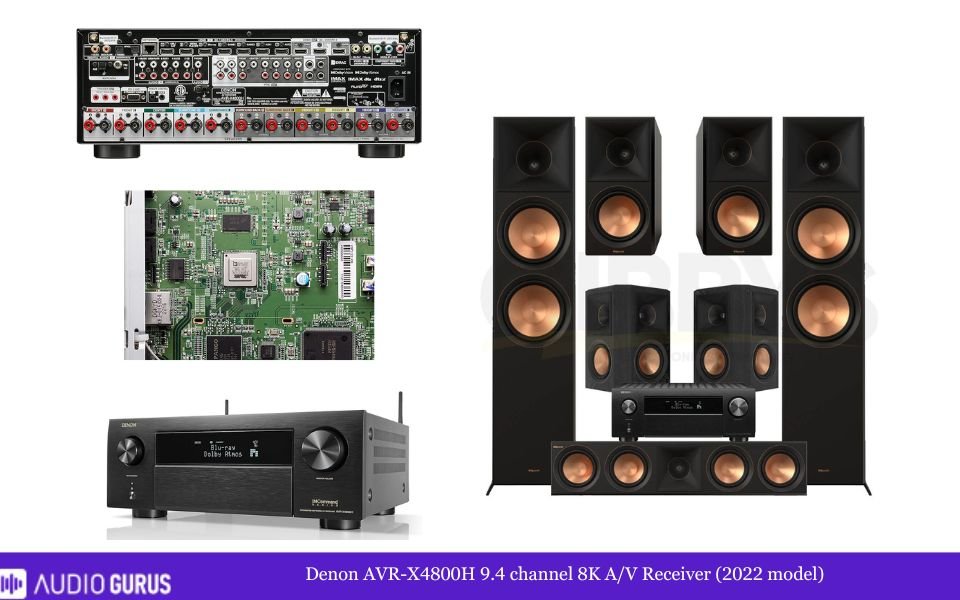
Most of the time, buying into the next generation of home theater can cost a lot of money. This receiver's $1,700 price tag makes this very clear. Denon's AVR-X4700H can do a lot for the things you already own, as well as for things you might buy in the future, like 8K TVs and 8K-compatible devices. When you think about this, it starts to show its long-term value.

The AVR-X4700 isn't a huge change from the AVR-X3700NH, but it does have more power. It has 125 watts per channel instead of the 105 watts its predecessor had. As far as the video goes, the AVR-X4700 still has support for 8K/60Hz, 4K/120Hz, Dolby Vision, and HDR10 (Dynamic HDR, HLG). The 8K upscaling you can do to your 4K Blu-rays and Netflix UHD subscriptions also comes with the new TVs. With 8 HDMI inputs and three HDMI outputs, you won't have to buy a selector for any more devices that you want to connect. We also like how Denon gave current and future-generation gamer features like Variable Refresh Rate (VRR), Quick Frame Transport (QFT), and Auto Low Latency Mode to both current and future-generation gamers (ALLM).

Audio-wise, the X4700 hasn't changed a thing. DTS:X, DTS: Virtual X, and other codecs with a lot of space are what we're talking about. Auro 3D is a three-dimensional audio alternative to Dolby Atmos. 5.2.4 or 7.2.2 traditional Atmos arrangements can be set up, or you can use the Dolby Atmos Height Virtualization feature to make it look like the sound is coming from the ceiling. You can also do the same thing with Auro 3D if that's what you prefer.

Fans of music will be right at home with the X4700's digital music support from services like Spotify, Pandora, Tidal, Soundcloud, and a lot of other things, like Spotify. There's also Denon HEOS support if you have a lot of Denon gear in your house, so you can use it with your home theater. Your phone can control and share all of the music you own. You can also teach the HEOS skill to your Echo speaker so that you can control it with your voice. X3700 also works with Google Assistant, Apple Siri, and Josh.ai, so you can use them as well.

Pros

· the best AV receiver for 8K PROS is this one.

· Ready for new content

· Player-friendly modes

CONS

· Everyone isn't interested in getting ready for 8K yet.
8.02 Mixed Usages
8.4 VIDEO FEATURES:
7.1 CONNECTIVITY OPTIONS:
7.9 AUDIO FEATURES:
8.6 MULTIZONE:
8.2 AMPLIFICATION:
Specification

General

Receiver Type A/V Receiver
Number Of Channel 5.1 , 9.4 Channel
Number Channel Processing 11
Audio Feature Dolby Atmos , DTS:X , Front Wide Ch. , Auro 3D
Video Feature HDR10
Watts Per Channel 125 W
Zones 4
Radio Internet Radio , Pandora , Spotify , Tidal , Deezer , Napster , SiriusXM
Amplifier Class G

Connectivity

Ethernet Yes
Wi-Fi Yes
Bluetooth Yes
USB Yes
RCA LIne Input: Available
RCA LIne Output: Available
RCA Pre-Outs: Available
XLR Line Inputs: Not specified
XLR Pre-Outs: Not specified
Phono Input: Yes
Optical Inputs: Not specified
Optical Output: Not specified
Coaxial Inputs: Not specified
Multi-Channel Input: Available
Headphone Out: Not specified
HDMI Inputs: Not specified
HDMI Outputs: Not specified
8K Inputs: Available
Composite Video Input Available
Composite Video Output: Available
Component Video Input: Available
Component Video Output: Available
Front A/V Inputs: Available
Speaker A/B: Not specified

AUDIO FEATURES:

Maximum Channel Processing 9.4 channels
Dolby Atmos True
Dolby Atmos Height Virtualization Yes
Dolby Atmos Music Yes
Dolby TrueHD Yes
Dolby Digital Plus Yes
Dolby Surround Upmixer Yes
Dolby Pro Logic Yes
Dolby Digital EX Yes
Surround EX Yes
DTS:X Yes
DTS Neural:X Yes
DTS Virtual:X Yes
DTS Neo Yes
DTS-HD Master Audio Yes
DTS-HD High Resolution Audio Yes
DTS 96/24
DTS Express Yes
DTS-ES Yes
IMAX Enhanced Yes
PCM Yes
Music Playback via USB Yes
High Resolution Music Playback via USB and/or Network Yes
High Resolution Audio Formats via USB Yes
Gapless Playback Yes
DSD via HDMI Yes
DSD via USB Yes
DSD to PCM Converter Yes
USB DAC Yes
Jitter Reduction Yes
DTS Dialog Control Yes
Dialog Enhancement Yes
Dialog Level Adjustment Yes
Dialog Normalization Yes
Dialogue Lift Yes
Compressed Music Enhancer Yes
High-resolution Music Enhancer Yes
Audyssey Dynamic EQ Yes
Audyssey Dynamic Volume Yes
Audyssey LFC Yes
Audyssey Sub EQ HT Yes
Audyssey DSX Yes
Direct Mode Yes
Pure Direct Mode Yes
Independent Subwoofer Outputs Yes
Auto Speaker Calibration System with Mic. YPAO
Audyssey App Support Yes
Bass Sync Yes
Optimized Bass Redirection Yes

VIDEO FEATURES:

HDMI Version HDMI v.1.4
Enhanced ARC Yes
HDCP Version Not specified
HDR10+ Yes
Dynamic HDR Yes
Dolby Vision Yes
HLG (Hybrid Log Gamma) Yes
QMS (Quick Media Switching) Yes
3-D Ready N/A
Video Signal Passthrough Yes
Video Signal Upscaling Yes
Analog To HDMI Upconversion Yes
Component Video Upscaling N/A
isf Certified Calibration Control N/A

Amplifiers

Channels 9.4 channels.
Front Wide Channel Support Yes
Current Feedback Topology Yes
Discrete Amplification Yes
HDAM Yes
THX™ Certification N/A
Continuous 6 Ω Rated N/A
Certified 4 Ω Performance N/A
Bi-amp Capability Not Specified

Gaming Features

Auto Low Latency Mode (ALLM) Yes
Variable Refresh Rate (VRR) Yes
Quick Frame Transport (QFT) Yes

Zones

Zones 4
Powered Zones Yes
Zone 2 Outs Available
Zone 3 Outs Available
RS-232C Interface Yes
+12V Trigger Output Yes

Radio

Analog Tuner Yes
Digital Radio Yes
Internet Radio Yes
Pandora Yes
Spotify Yes
Tidal Yes
Deezer Yes
SiriusXM Internet Radio Yes
Napster Yes

Additional Features

On-Screen Display Available
GUI Languages Multiple language options
Web Browser Control Yes
IP Control for CI Yes
Control4 SDDP Yes
PreAmp Mode Yes
Display Yes
Remote Controller RC-1252
Remote Control In/Out 1/1
LCD Display Yes
Detachable Power Cord N/A
Setup Assistant N/A

Power

Power Output (6 Ω, 1 kHz, 2 125W
Rated Power Output (6 Ω, 1 kHz, 1 channel driven, IEC) No
Dynamic Power per Channel (3 Ω, Front) No
Dynamic Power per Channel (4 Ω, Front) No
Dynamic Power per Channel (8 Ω, Front) No
Power Output (8 Ω, 20 Hz - 20 kHz, 2 No
Maximum Effective Power Output (6 Ω, 1 kHz, 1 channel driven, JEITA) No
Power Supply AC 120 V, 60 Hz
Toroidal Transformer Yes
Power Consumption 70 W
No Sound Power Yes
Standby Power Yes

Rating System

AUDIO FEATURES: 7.85
VIDEO FEATURES: 8.38
CONNECTIVITY OPTIONS: 7.11
MULTIZONE: 8.57
AMPLIFICATION: 8.21

Build

Dimensions (W x H x D) 435 mm x 173 mm x 435 mm
Weight 13.2 KG
Chassis Yes
Front Panel Yes
Speaker Terminals Yes
Large Speaker Terminals Yes
Color-Coded Speaker Terminals Yes
Transparent High-Grade Speaker Terminals Yes
High Grade Audio Components Yes
ECO Mode / Hybrid Standby Function Yes
Auto Power off Yes
Warranty 3 Years

Specifications

THD digital 0.01% at +20 dBu,
Analog Distortion Not Specified
Phono Distortion Not Specified
Input Sensitivity and Impedance (Line) 200 mV
Input Sensitivity and Impedance (Phono MM) Not Specified
Rated Lineout Level and Impedance 0.09 ohms
Rated Output digital Not Specified
S/N Ratio (Line, IHF-A) 74 dB (IHF-A)
S/N Ratio (Phono MM, IHF-A) 92 dB
S/N Ratio (digital) 118 dB
Phono RIAA Deviation ±1 dB (20 Hz to 20 kHz
Frequency Response (Analog In) 20Hz–20kHz
DSD Sampling Rates via HDMI 2.8MHz, 5.6MHz, and 11.2MHz
DSD Sampling Rates via USB 2.8MHz and 5.6MHz
Video Input Sensitivity/Output Level and Impedance 1 Vp-p, 75 Ω/ohm
Video Frequency Response 2 Hz to 100 MHz
Ethernet Standard Not Specified
Wi-Fi Standard Not Specified
Wi-Fi Terminal Frequency 2.4 GHz and 5 GHz
Bluetooth Version 5.0
Bluetooth Frequency 2.4 GHz.
USB Terminal 24-bit/192kHz
FM Frequency 87.5 MHz to 108 MHz
FM 50 dB Quiet Sensitivity (IHF, 1 kHz, 100% MOD.) MONO ― 2.8 μV (20.2 dBf)
FM S/N Ratio 112 dB
FM Harmonic Distortion (IHF, 1 kHz) 0.09%.
AM Effective Sensitivity 1.2 μV (12.8 dBf). 18 μV.
AM Frequency 535 to 1705 kHz.

Onkyo TX-NR 6100 Review:

People who want to stay in the middle of the price range but still have access to the most up-to-date features and standards will love this Onkyo TV. It's also a good choice for gamers or people who want to improve their movie experience. Seven-channel receiver: 80 watts per channel into 8 ohms at 0.08 percent THD with two channels used. When you need to keep the noise level down while you're playing games, there's a headphone jack. There are four HDMI 2.1 ports in and two out with HDCP 2.3 support, optical, coaxial, stereo RCA ports, USB ports, and dual subwoofer RCA ports.

There are a lot more supported standards for this Onkyo TV when we look into them. Sonos Port, AirPlay 2, Bluetooth, Chromecast, Alexa and Google Assistant can all be used with this speaker. It can also be used with Dolby Atmos or DTS:X processing. You can use it with ARC/eARC as well as Wi-Fi. Another thing that this receiver can do is optimize for HDR10+ and Dolby Vision, as well as HLG (Hybrid Log-Gamma). This makes it a good choice for a lot of different things.

Variable Refresh Rate (VRR), Auto Low Latency Mode (ALLM), and Quick Frame Transport (QFT) are some of the features that make the Onkyo TX-NR5100 a good choice for gamers. These features can help improve frame rate performance and cut down on issues with lag.

Pros

· The best mid-range A/V model

· A lot of support for the current standards and voice assistants.

· Optimized for gamers

· Good features for a price that isn't too high or too low

CONS

· there is no support for 8K

· Wattage isn't as high as it is with high-end picks.

7.44 Mixed Usages
7 VIDEO FEATURES:
8 CONNECTIVITY OPTIONS:
7.1 AUDIO FEATURES:
6.9 MULTIZONE:
8.2 AMPLIFICATION:
Specification

General

Receiver Type A/V Receiver
Number Of Channel 7.2 Channel
Number Channel Processing 7
Audio Feature Dolby Atmos , DTS:X
Video Feature HDR10 , HDR10+ , Dolby Vision , 8K Passthrough , 4K Upscaling
Watts Per Channel 100 W
Zones 2
Radio Internet Radio , Pandora , Spotify , Tidal , Deezer
Amplifier Class A/B , Non-Phase

Connectivity

Ethernet Yes
Wi-Fi Yes
Bluetooth Yes
USB Yes
RCA LIne Input: 4
RCA LIne Output: No
RCA Pre-Outs: 0.2
XLR Line Inputs: No
XLR Pre-Outs: No
Phono Input: Yes
Optical Inputs: 1
Optical Output: No
Coaxial Inputs: 1
Multi-Channel Input: No
Headphone Out: 6.3 mm (1/4
HDMI Inputs: 6
HDMI Outputs: 2 (1 Main, 1 Sub/Zone2)
8K Inputs: 3
Composite Video Input No
Composite Video Output: No
Component Video Input: No
Component Video Output: No
Front A/V Inputs: USB
Speaker A/B: No

AUDIO FEATURES:

Maximum Channel Processing 7.1
Dolby Atmos Yes
Dolby Atmos Height Virtualization Yes
Dolby Atmos Music N/A
Dolby TrueHD Yes
Dolby Digital Plus Yes
Dolby Surround Upmixer Yes
Dolby Pro Logic N/A
Dolby Digital EX N/A
Surround EX N/A
DTS:X Yes
DTS Neural:X Yes
DTS Virtual:X Yes
DTS Neo N/A
DTS-HD Master Audio Yes
DTS-HD High Resolution Audio Yes
DTS 96/24 Yes
DTS Express Yes
DTS-ES Yes
IMAX Enhanced N/A
PCM PCM
Music Playback via USB 2-ch/Multi-ch Input Music Playback via USB FLAC, WAV, Apple Lossless, WMA, MP3, DSD, AIFF, AAC, Dolby TrueHD
High Resolution Music Playback via USB and/or Network up to 192 kHz
High Resolution Audio Formats via USB FLAC, WAV, Apple Lossless, DSD, AIFF, AAC, Dolby TrueHD
Gapless Playback Yes
DSD via HDMI 2-ch/Multi-ch Input
DSD via USB 2-ch Input
DSD to PCM Converter N/A
USB DAC N/A
Jitter Reduction Yes
DTS Dialog Control Yes
Dialog Enhancement N/A
Dialog Level Adjustment N/A
Dialog Normalization Yes
Dialogue Lift N/A
Compressed Music Enhancer Advanced Music Optimizer
High-resolution Music Enhancer N/A
Audyssey Dynamic EQ N/A
Audyssey Dynamic Volume N/A
Audyssey LFC N/A
Audyssey Sub EQ HT N/A
Audyssey DSX N/A
Direct Mode Yes
Pure Direct Mode Yes
Independent Subwoofer Outputs N/A
Auto Speaker Calibration System with Mic. AccuEQ with subwoofer EQ and AccuReflex™
Audyssey App Support N/A
Bass Sync N/A
Optimized Bass Redirection N/A

VIDEO FEATURES:

HDMI Version 2.1
Enhanced ARC Yes
HDCP Version 2.3
HDR10+ Yes
Dynamic HDR N/A
Dolby Vision Yes
HLG (Hybrid Log Gamma) Yes
QMS (Quick Media Switching) Yes
3-D Ready Yes
Video Signal Passthrough Yes
Video Signal Upscaling Yes
Analog To HDMI Upconversion N/A
Component Video Upscaling N/A
isf Certified Calibration Control N/A

Amplifiers

Channels 7.2
Front Wide Channel Support N/A
Current Feedback Topology Yes
Discrete Amplification Yes
HDAM N/A
THX™ Certification Yes
Continuous 6 Ω Rated Yes
Certified 4 Ω Performance Yes
Bi-amp Capability Yes

Gaming Features

Auto Low Latency Mode (ALLM) Yes
Variable Refresh Rate (VRR) Yes
Quick Frame Transport (QFT) Yes

Zones

Zones 2
Powered Zones 2
Zone 2 Outs RCA Line Out (shared with Zone B)
Zone 3 Outs No
RS-232C Interface N/A
+12V Trigger Output 0

Radio

Analog Tuner FM/AM
Digital Radio N/A
Internet Radio TuneIn
Pandora Yes
Spotify Yes
Tidal Yes
Deezer Yes
SiriusXM Internet Radio N/A
Napster N/A

Additional Features

On-Screen Display No
GUI Languages No
Web Browser Control N/A
IP Control for CI Yes
Control4 SDDP N/A
PreAmp Mode N/A
Display No
Remote Controller No
Remote Control In/Out No
LCD Display N/A
Detachable Power Cord N/A
Setup Assistant N/A

Power

Power Output (6 Ω, 1 kHz, 2 No
Rated Power Output (6 Ω, 1 kHz, 1 channel driven, IEC) No
Dynamic Power per Channel (3 Ω, Front) 240 W
Dynamic Power per Channel (4 Ω, Front) 210 W
Dynamic Power per Channel (8 Ω, Front) 120 W
Power Output (8 Ω, 20 Hz - 20 kHz, 2 100 W (0.08% THD)
Maximum Effective Power Output (6 Ω, 1 kHz, 1 channel driven, JEITA) 210 W (10% THD)
Power Supply AC 120 V, 60 Hz
Toroidal Transformer N/A
Power Consumption 635 W
No Sound Power 65 W
Standby Power 0.1 W

Rating System

AUDIO FEATURES: 7.05
VIDEO FEATURES: 7.04
CONNECTIVITY OPTIONS: 8.01
MULTIZONE: 6.86
AMPLIFICATION: 8.24

Build

Dimensions (W x H x D) 17-1/8
Weight 9.8kg
Chassis No
Front Panel No
Speaker Terminals 9
Large Speaker Terminals 9
Color-Coded Speaker Terminals N/A
Transparent High-Grade Speaker Terminals N/A
High Grade Audio Components N/A
ECO Mode / Hybrid Standby Function Yes
Auto Power off N/A
Warranty 3 years

Specifications

THD digital 0.08% (20 Hz - 20 kHz, Half power)
Analog Distortion No
Phono Distortion No
Input Sensitivity and Impedance (Line) 200 mV/47 kΩ (1 kHz, 100 W/8 Ω)
Input Sensitivity and Impedance (Phono MM) 3.5 mV/47 kΩ
Rated Lineout Level and Impedance 1 V/470 Ω (subwoofer)
Rated Output digital No
S/N Ratio (Line, IHF-A) 106 dB
S/N Ratio (Phono MM, IHF-A) 80 dB
S/N Ratio (digital) No
Phono RIAA Deviation No
Frequency Response (Analog In) 10 Hz - 100 kHz/+1 dB, -3 dB (Direct/Pure Audio)
DSD Sampling Rates via HDMI 2.8 MHz
DSD Sampling Rates via USB 2.8 MHz, 5.6 MHz, 11.2 MHz
Video Input Sensitivity/Output Level and Impedance No
Video Frequency Response No
Ethernet Standard 10BASE-T/100BASE-TX
Wi-Fi Standard IEEE 802.11 a/b/g/n/ac
Wi-Fi Terminal Frequency 5 GHz, 2.4 GHz
Bluetooth Version 4.2
Bluetooth Frequency 2.4 GHz
USB Terminal Front: Ver. 2.0, 5 V, 0.5 A Rear: Ver. 2.0, 5 V, 1 A
FM Frequency 87.5 MHz - 107.9 MHz
FM 50 dB Quiet Sensitivity (IHF, 1 kHz, 100% MOD.) _1.0 µV (11.2 dBf)
FM S/N Ratio No
FM Harmonic Distortion (IHF, 1 kHz) No
AM Effective Sensitivity No
AM Frequency 530 kHz - 1710 kHz

Yamaha RX-A2A Review:

The RX-A2A is part of Yamaha's top-of-the-line Aventage line, and it's been given a new look and new connectivity that will make it last for years to come.

RX-A2A: It has seven full-range channels of power, each with 100W into eight ohms in stereo, and two subwoofer outputs. This means it can run up to 7.1 speaker configurations or, if you use Dolby Atmos or DTS:X decoding, a 5.1.2 set-up, depending on how many speakers you have.

It has a great sound and is very responsive. It has punchy transients, a wide sound field, and a lot of musical drive.

MusicCast is an app made by Yamaha that lets you stream music. It can play high-res and lossless formats like Apple Lossless (ALAC) up to 96kHz, WAV, FLAC or AIFF up to 192kHz, and services like Spotify and Tidal can be played. On top of that, there's also AirPlay 2 and Bluetooth (SBC or AAC) and Google Assistant or Alexa compatibility for voice control. There's also a DAB+ and FM/AM tuner, too.

There are a lot of things that Yamaha plans to do to the RX-A2A in order to make it work properly. It will be able to play back 4K at 120Hz and 8K at 60Hz through three of its seven HDMI inputs in the future.

It will take a series of firmware updates to make these features, as well as other next-generation HDMI updates and HDR10+, available. This Autumn, these features will only be available thanks to these updates. Besides the free hardware upgrade, the Xbox One X and Nvidia RTX30-series graphics cards that can play 4K at 120Hz will also be able to play it.

You might not care about this, though, if you're a real gamer. For movies, the RX-A2A can handle 4K signals at up to 60 frames per second, which no source can do right now, and it can play HDR10 and Dolby Vision video formats.

Pros

· Agility and responsiveness

· Spacious but focused presentation

· Exciting personality

Cons

· May not have enough authority

· HDMI 2.1 features need to be updated

8.84 Mixed Usages
9.9 VIDEO FEATURES:
8.5 CONNECTIVITY OPTIONS:
8.9 AUDIO FEATURES:
8 MULTIZONE:
8.9 AMPLIFICATION:
Specification

General

Receiver Type A/V Receiver
Number Of Channel 7.2 Channel
Number Channel Processing 7
Audio Feature Dolby Atmos , DTS:X
Video Feature HDR10 , HDR10+ , Dolby Vision , 8K Passthrough , 4K Upscaling
Watts Per Channel 100
Zones 2
Radio Internet Radio , Pandora , Spotify , Tidal , Deezer , Napster , SiriusXM
Amplifier

Connectivity

Ethernet Yes
Wi-Fi Yes
Bluetooth Yes
USB Yes
RCA LIne Input: 3
RCA LIne Output: N/A
RCA Pre-Outs: 2.2
XLR Line Inputs: N/A
XLR Pre-Outs: N/A
Phono Input: Yes
Optical Inputs: 1
Optical Output: N/A
Coaxial Inputs: 1
Multi-Channel Input: N/A
Headphone Out: 6.3 mm (1/4
HDMI Inputs: 7
HDMI Outputs: 1
8K Inputs: 7
Composite Video Input N/A
Composite Video Output: N/A
Component Video Input: N/A
Component Video Output: N/A
Front A/V Inputs: N/A
Speaker A/B: N/A

AUDIO FEATURES:

Maximum Channel Processing 7.1
Dolby Atmos YES
Dolby Atmos Height Virtualization Yes
Dolby Atmos Music N/A
Dolby TrueHD Yes
Dolby Digital Plus Yes
Dolby Surround Upmixer Yes
Dolby Pro Logic N/A
Dolby Digital EX N/A
Surround EX N/A
DTS:X YES
DTS Neural:X Yes
DTS Virtual:X
DTS Neo Yes
DTS-HD Master Audio Yes
DTS-HD High Resolution Audio Yes
DTS 96/24 Yes
DTS Express Yes
DTS-ES YES
IMAX Enhanced N/A
PCM 2-ch/Multi-ch Input
Music Playback via USB MP3, WMA, MPEG-4 AAC, Apple Lossless, WAV, FLAC, AIFF, DSD
High Resolution Music Playback via USB and/or Network Up to 192 kHz/32 Bit
High Resolution Audio Formats via USB Apple Lossless, WAV, FLAC, AIFF, DSD
Gapless Playback Yes
DSD via HDMI 2-ch/Multi-ch Input
DSD via USB 2-ch Input
DSD to PCM Converter N/A
USB DAC N/A
Jitter Reduction N/A
DTS Dialog Control Yes
Dialog Enhancement N/A
Dialog Level Adjustment Yes
Dialog Normalization Yes
Dialogue Lift Yes
Compressed Music Enhancer YES
High-resolution Music Enhancer N/A
Audyssey Dynamic EQ N/A
Audyssey Dynamic Volume N/A
Audyssey LFC N/A
Audyssey Sub EQ HT N/A
Audyssey DSX N/A
Direct Mode
Pure Direct Mode Yes
Independent Subwoofer Outputs N/A
Auto Speaker Calibration System with Mic. YPAO sound optimization with Multipoint Measurement
Audyssey App Support
Bass Sync
Optimized Bass Redirection

VIDEO FEATURES:

HDMI Version 2.1
Enhanced ARC Yes
HDCP Version 2.3
HDR10+ Yes
Dynamic HDR N/A
Dolby Vision Yes
HLG (Hybrid Log Gamma) Yes
QMS (Quick Media Switching) Yes
3-D Ready Yes
Video Signal Passthrough Yes
Video Signal Upscaling Yes
Analog To HDMI Upconversion N/A
Component Video Upscaling N/A
isf Certified Calibration Control N/A

Amplifiers

Channels 7.2
Front Wide Channel Support Yes
Current Feedback Topology
Discrete Amplification
HDAM
THX™ Certification N/A
Continuous 6 Ω Rated Yes
Certified 4 Ω Performance Yes
Bi-amp Capability YES

Gaming Features

Auto Low Latency Mode (ALLM) Yes
Variable Refresh Rate (VRR) Yes
Quick Frame Transport (QFT) Yes

Zones

Zones 2
Powered Zones Zone 2
Zone 2 Outs RCA Preout
Zone 3 Outs N./A
RS-232C Interface N/A
+12V Trigger Output 1

Radio

Analog Tuner FM/AM
Digital Radio N/A
Internet Radio YES
Pandora Yes
Spotify Yes
Tidal Yes
Deezer Yes
SiriusXM Internet Radio Yes
Napster Yes

Additional Features

On-Screen Display Graphical User Interface
GUI Languages YES
Web Browser Control Yes
IP Control for CI
Control4 SDDP
PreAmp Mode N/A
Display LCD
Remote Controller YES
Remote Control In/Out 1/1
LCD Display Yes
Detachable Power Cord Yes
Setup Assistant

Power

Power Output (6 Ω, 1 kHz, 2
Rated Power Output (6 Ω, 1 kHz, 1 channel driven, IEC) 125 W (0.9% THD)
Dynamic Power per Channel (3 Ω, Front)
Dynamic Power per Channel (4 Ω, Front)
Dynamic Power per Channel (8 Ω, Front)
Power Output (8 Ω, 20 Hz - 20 kHz, 2 100 W (0.06% THD)
Maximum Effective Power Output (6 Ω, 1 kHz, 1 channel driven, JEITA) 160 W (10% THD)
Power Supply AC 120 V, 60 Hz
Toroidal Transformer
Power Consumption 360 W
No Sound Power
Standby Power 0.1 W

Rating System

AUDIO FEATURES: 8.9
VIDEO FEATURES: 9.9
CONNECTIVITY OPTIONS: 8.5
MULTIZONE: 8.01
AMPLIFICATION: 8.88

Build

Dimensions (W x H x D) 17-1/8
Weight 10.2 kg (22.5 lbs)
Chassis
Front Panel
Speaker Terminals 9
Large Speaker Terminals 9
Color-Coded Speaker Terminals Yes
Transparent High-Grade Speaker Terminals
High Grade Audio Components
ECO Mode / Hybrid Standby Function Yes
Auto Power off Yes
Warranty 3 Years

Specifications

THD digital 0.04% (AUDIO 3 etc. to Front, Pure Direct, 20 Hz - 20 kHz, 50 W, 8 Ω)
Analog Distortion
Phono Distortion
Input Sensitivity and Impedance (Line) 200 mV/47 kΩ
Input Sensitivity and Impedance (Phono MM) 3.5 mV/47 kΩ
Rated Lineout Level and Impedance
Rated Output digital
S/N Ratio (Line, IHF-A) 110 dB
S/N Ratio (Phono MM, IHF-A) 95 dB
S/N Ratio (digital)
Phono RIAA Deviation 0±0.5 dB (20 Hz - 20 kHz)
Frequency Response (Analog In) +0/-3 dB (AUDIO 3 etc. to Front, Pure Direct, 10 Hz to 100 kHz)
DSD Sampling Rates via HDMI 2.8 MHz
DSD Sampling Rates via USB 11.2 MHz, 5.6 MHz, 2.8 MHz
Video Input Sensitivity/Output Level and Impedance
Video Frequency Response
Ethernet Standard 10BASE-T/100BASE-TX
Wi-Fi Standard IEEE 802.11 a/b/g/n/ac
Wi-Fi Terminal Frequency 2.4 GHz, 5 GHz
Bluetooth Version 4.2
Bluetooth Frequency 2.4 GHz
USB Terminal USB2.0 5 V, 1 A
FM Frequency 87.5 MHz - 107.9 MHz
FM 50 dB Quiet Sensitivity (IHF, 1 kHz, 100% MOD.) Mono: 3 µV (20.8 dBf)
FM S/N Ratio Mono/Stereo: 69 dB/68 dB
FM Harmonic Distortion (IHF, 1 kHz) Mono/Stereo: 0.5%/0.6%
AM Effective Sensitivity
AM Frequency 530 kHz - 1710 kHz

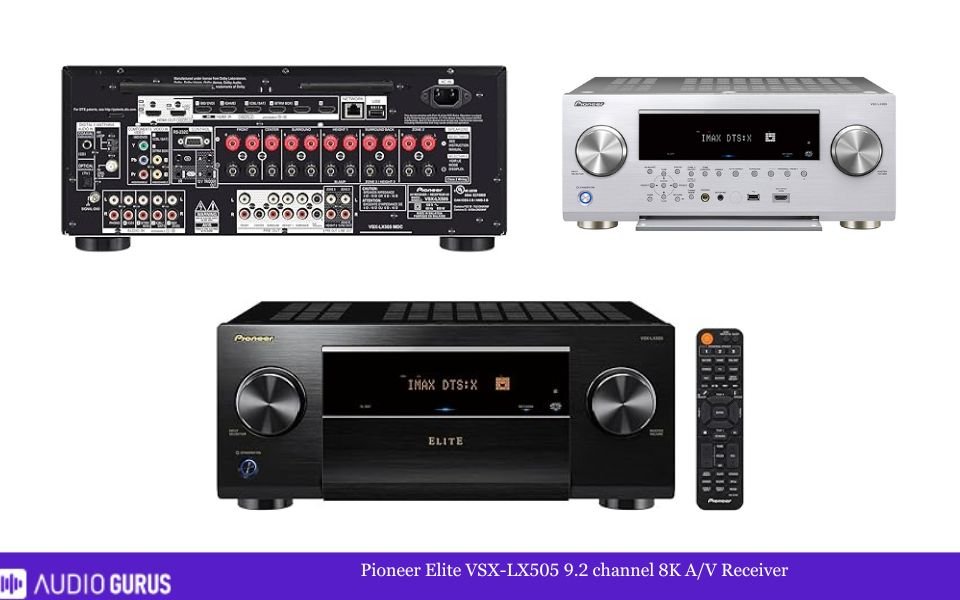
The Pioneer Elite VSX-LX505

This Dolby Atmos AV receiver has nine channels and is suitable for speaker configurations of 5.2.4 or 7.2.2. It is available in black and white. The HDMI configuration includes seven inputs (including one on the front facia) and two outputs. There is Dolby Vision support, but there is no 8K support. There are only two digital audio inputs available: one coaxial and one optical.

Pioneer AVRs have a distinctively crisp delivery that can sound overly analytical at times, but we enjoyed the character of the AVRs we tested throughout our listening tests. Also included is a Reflex Optimizer feature that allows you to fine-tune up-firing Dolby Atmos speakers. Apart from that, this receiver offers built-in Chromecast and Google Assistant support, in addition to Apple Airplay 2 and support for DTS Play-Fidelity technology. In terms of value for money, it's difficult to disagree with this gleaming Pioneer at this pricing.

Pros

· high-end video game console.

· Extremely powerful amplification for the money

· Customizable sound presets

Cons

· There is no 8K/4K 120fps video

· A limited number of digital interfaces are available
7.21 Mixed Usages
7.1 VIDEO FEATURES:
7.1 CONNECTIVITY OPTIONS:
6.5 AUDIO FEATURES:
7.6 MULTIZONE:
7.8 AMPLIFICATION:
Specification

General

Receiver Type A/V Receiver
Number Of Channel 9.2 Channel
Number Channel Processing 9
Audio Feature Dolby Atmos , DTS:X
Video Feature HDR10 , HDR10+ , Dolby Vision , 8K Passthrough , 8K Upscaling
Watts Per Channel 120 W
Zones 3
Radio Internet Radio , Pandora , Spotify , Tidal , Deezer
Amplifier Class A/B

Connectivity

Ethernet Yes
Wi-Fi Yes
Bluetooth Yes
USB Yes
RCA LIne Input: 7
RCA LIne Output: 2
RCA Pre-Outs: 11.2 (barter to Zone 3 out)
XLR Line Inputs: No
XLR Pre-Outs: No
Phono Input: Yes
Optical Inputs: 1
Optical Output: No
Coaxial Inputs: 1
Multi-Channel Input: No
Headphone Out: 6.3 mm (1/4")
HDMI Inputs: 7 (1 front)
HDMI Outputs: 2 (1 MAIN, 1 SUB/ZONE 2)
8K Inputs: 6
Composite Video Input 2
Composite Video Output: No
Component Video Input: 1
Component Video Output: No
Front A/V Inputs: HDMI, USB
Speaker A/B: No

AUDIO FEATURES:

Maximum Channel Processing 9.2
Dolby Atmos Yes
Dolby Atmos Height Virtualization Yes
Dolby Atmos Music N/A
Dolby TrueHD Yes
Dolby Digital Plus Yes
Dolby Surround Upmixer Yes
Dolby Pro Logic N/A
Dolby Digital EX N/A
Surround EX N/A
DTS:X Yes
DTS Neural:X Yes
DTS Virtual:X N/A
DTS Neo N/A
DTS-HD Master Audio N/A
DTS-HD High Resolution Audio Yes
DTS 96/24 Yes
DTS Express Yes
DTS-ES Discrete 6.1, Matrix 6.1
IMAX Enhanced Yes
PCM 2-ch/Multi-ch Input
Music Playback via USB MP3, WMA, AAC, Apple Lossless, WAV, FLAC, LPCM, AIFF, DSD
High Resolution Music Playback via USB and/or Network up to 192 kHz/24 bit
High Resolution Audio Formats via USB Apple Lossless, WAV, FLAC, AIFF, AAC, DSD
Gapless Playback Yes
DSD via HDMI 2-ch/Multi-ch Input
DSD via USB 2-ch Input
DSD to PCM Converter N/A
USB DAC N/A
Jitter Reduction N/A
DTS Dialog Control Yes
Dialog Enhancement Yes
Dialog Level Adjustment N/A
Dialog Normalization N/A
Dialogue Lift N/A
Compressed Music Enhancer Advanced Sound Retriever
High-resolution Music Enhancer N/A
Audyssey Dynamic EQ N/A
Audyssey Dynamic Volume N/A
Audyssey LFC N/A
Audyssey Sub EQ HT N/A
Audyssey DSX N/A
Direct Mode Yes
Pure Direct Mode Yes
Independent Subwoofer Outputs Yes
Auto Speaker Calibration System with Mic. Advanced MCACC and Dirac Live™ Room Correction
Audyssey App Support N/A
Bass Sync N/A
Optimized Bass Redirection N/A

VIDEO FEATURES:

HDMI Version 2.1
Enhanced ARC Yes
HDCP Version 2.3
HDR10+ Yes
Dynamic HDR N/A
Dolby Vision Yes
HLG (Hybrid Log Gamma) Yes
QMS (Quick Media Switching) Yes
3-D Ready Yes
Video Signal Passthrough Yes
Video Signal Upscaling Yes
Analog To HDMI Upconversion N/A
Component Video Upscaling N/A
isf Certified Calibration Control N/A

Amplifiers

Channels 9.2
Front Wide Channel Support N/A
Current Feedback Topology N/A
Discrete Amplification N/A
HDAM N/A
THX™ Certification N/A
Continuous 6 Ω Rated Yes
Certified 4 Ω Performance Yes
Bi-amp Capability Yes

Gaming Features

Auto Low Latency Mode (ALLM) Yes
Variable Refresh Rate (VRR) Yes
Quick Frame Transport (QFT) Yes

Zones

Zones 3
Powered Zones 2 and 3
Zone 2 Outs HDMI, RCA Pre/Line Out (shared with Zone B line out)
Zone 3 Outs RCA Pre/Line Out
RS-232C Interface N/A
+12V Trigger Output 2 (A: 100 mA, B: 25 mA)

Radio

Analog Tuner FM/AM
Digital Radio N/A
Internet Radio TuneIn
Pandora Yes
Spotify Yes
Tidal
Deezer Yes
SiriusXM Internet Radio
Napster N/A

Additional Features

On-Screen Display Yes
GUI Languages 7
Web Browser Control Yes
IP Control for CI Yes
Control4 SDDP Yes
PreAmp Mode Yes
Display Yes
Remote Controller RC-974R
Remote Control In/Out 1 / 1
LCD Display Yes
Detachable Power Cord Yes
Setup Assistant N/A

Power

Power Output (6 Ω, 1 kHz, 2 120 W
Rated Power Output (6 Ω, 1 kHz, 1 channel driven, IEC) 215 W
Dynamic Power per Channel (3 Ω, Front) 300 W
Dynamic Power per Channel (4 Ω, Front) 250 W
Dynamic Power per Channel (8 Ω, Front) 150 W
Power Output (8 Ω, 20 Hz - 20 kHz, 2 80 W
Maximum Effective Power Output (6 Ω, 1 kHz, 1 channel driven, JEITA) 230 W
Power Supply AC 120 V, 60 Hz
Toroidal Transformer N/A
Power Consumption 570 W
No Sound Power 65 W
Standby Power 0.15 W

Rating System

AUDIO FEATURES: 6.48
VIDEO FEATURES: 7.1
CONNECTIVITY OPTIONS: 7.12
MULTIZONE: 7.62
AMPLIFICATION: 7.75

Build

Dimensions (W x H x D) 435 x 185 x 441 mm
Weight 13.8 kg
Chassis Steel
Front Panel Aluminum
Speaker Terminals 11
Large Speaker Terminals 11
Color-Coded Speaker Terminals Yes
Transparent High-Grade Speaker Terminals N/A
High Grade Audio Components Yes
ECO Mode / Hybrid Standby Function Yes
Auto Power off Yes
Warranty 2 Years

Specifications

THD digital 0.08% (20 Hz - 20 kHz, Half Power)
Analog Distortion 0.08% (20 Hz - 20 kHz, Half Power)
Phono Distortion 0.08% (20 Hz - 20 kHz, Half Power)
Input Sensitivity and Impedance (Line) 200 mV/47 kΩ
Input Sensitivity and Impedance (Phono MM) 3.5 mV/47 kΩ
Rated Lineout Level and Impedance 1 V/2.2 kΩ
Rated Output digital 0.5 Vp-p/75 Ω
S/N Ratio (Line, IHF-A) 106 dB
S/N Ratio (Phono MM, IHF-A) 80 dB
S/N Ratio (digital) 103 dB
Phono RIAA Deviation 20 Hz - 20 kHz, ±0.5 dB
Frequency Response (Analog In) 10 Hz - 100 kHz, +1 dB/-3 dB
DSD Sampling Rates via HDMI 2.8 MHz, 5.6 MHz
DSD Sampling Rates via USB 2.8 MHz, 5.6 MHz, 11.2 MHz
Video Input Sensitivity/Output Level and Impedance 1 Vp-p/75 Ω
Video Frequency Response 5 Hz - 10 MHz, +0 dB/-3 dB
Ethernet Standard IEEE802.3 10BASE-T/IEEE802.3u 100BASE-TX
Wi-Fi Standard IEEE802.11 a/b/g/n/ac
Wi-Fi Terminal Frequency 2.4 GHz/5 GHz
Bluetooth Version 4.2
Bluetooth Frequency 2.4 GHz
USB Terminal Type A
FM Frequency 87.5 MHz - 108 MHz
FM 50 dB Quiet Sensitivity (IHF, 1 kHz, 100% MOD.) 1.6 µV (17.3 dBf)
FM S/N Ratio 73 dB (Mono), 70 dB (Stereo)
FM Harmonic Distortion (IHF, 1 kHz) 0.5% (Mono), 0.8% (Stereo)
AM Effective Sensitivity 18 µV
AM Frequency 522 kHz - 1611 kHz

How to Choose the Best Surround Receiver for You

Receiver up to a certain point This is by far the most important factor to take into consideration. If you only intend to use your new receiver for music, you should purchase a stereo receiver. An AV receiver is required if you want to use surround sound in your home theater system. If you're looking for a receiver that can handle both music and home theater, the AV receiver is a great choice.

· Make sure you have enough channels for the present and the future. One speaker equals one channel. Check to see that your new receiver has enough channels to accommodate all of the speakers you currently have, as well as any additional speakers you may want to purchase in the future. There must be at least five channels if you want to enjoy surround sound.

Consider everything and anyone with whom you'll be establishing a connection. Take into account every single source you'll want to connect to, both now and in the future. For example, if you want to use your computer to play vinyl records, you'll need a phono input. If you want to listen to music wirelessly, you'll need to have Wi-Fi onboard, among other things. (In addition to Bluetooth, Airplay, and other similar technologies, so you can play music from your smartphone and tablet however you want.) The more connectivity your new receiver provides, the better, because you'll want to be able to connect any new gadget or device that you purchase in the future.

· The investment in state-of-the-art video switching is worthwhile. Even if you do not have a 4K television, 4K video switching is an absolute must-have feature. Check that you can connect any and all video sources, such as a DVD player or an Apple TV, to your system. It is all about

connecting multiple 4K-capable devices to a single display via an audio-visual receiver when using 4K switching.

· Make sure to purchase a receiver that is compatible with Dolby Atmos technology. Consider this: incredible, 3D-like sound that seems to hover all around you. Also available is Dolby Atmos-like DTS:X, a new surround sound format that is intended to make home theater audio more immersive, similar to Dolby Atmos. The good news is that the majority of new AV receivers are capable of playing both formats.

Frequently Asked Questions
Is it a bad idea to leave a surround receiver turned on all of the time?

Although it is not the best habit, it will not cause significant harm. AV receivers today are designed to be able to go into standby mode while using the least amount of power possible.

Is it necessary to ventilate an A/V receiver?

It is critical to have adequate ventilation in order to prevent the receiver from overheating. In the case of Denon, the manufacturer recommends that you give its receivers at least five inches of space on top and two inches of space on either side. Depending on how hot the amplifier inside gets, it might decide to shut down on its own to protect itself.

What number of channels should an audio/video receiver have?

In light of the fact that receivers are built to last for a long time, it's a good idea to get as many channels as possible so that you have the option of upgrading to more surround sound down the road. Even if you don't currently use that many speakers, we recommend that you invest in at least a 7.1-channel system.

Is it possible to put my receiver in a cabinet?

There are two things you need to think about when you put an AV receiver in a cabinet. AV receivers need air and must be able to move. In the same way as other AV components, AV receivers can be controlled with IR remotes. Many people today have apps that you can use from your phone. All have IR control, though. In this case, you'll need an IR solution (like a receiver extender) that can send the IR commands to your TV's AV receiver without you having to use your phone.

Second, your AV receiver needs to be able to breathe. This is very important. AV receivers can make a lot of noise and heat. A lot of problems can happen if that heat doesn't have a way to get away from the person who's getting it. There is a lot of things you can do, from turning it off to bricking it. If you read the manual for your AV receiver, there will be suggestions about how to ventilate the unit. Then, follow them.

Is it really important what the inputs labels called?

This is what you'll see on the back of your AV receiver: A ton of different ports. Labels like Blu-ray, DVD and so on will be there. They will also have names like Sat and Game. People don't like these labels, and they make them feel stressed out, It takes them a long time to make sure they plug the right thing into the right place. There are many people who are afraid to use the wrong input on their AV receivers.

No, for the most part. They are just labels that the manufacturer put on things. Most of the time, you can change these labels in the receiver's menu to show up on the screen how you want. That one is better for your cable box and another is better for your game system doesn't mean that one is better than the other. The labels on the back of the receiver are just there to help you remember what you plugged in and where on the back.

All other inputs are the same except for HDMI 2.1. At this point, there are many receivers that only have a few HDMI 2.1 ports. All of your next-generation gaming consoles (Xbox Series X/S or PlayStation 5) need HDMI 2.1 inputs, no matter what the name says. If you don't, you won't be able to play games with the new HDMI 2.1 features.

Final Words:

It's clear from our roundup that the AVR market has many choices and a wide range of prices. Think about how much it will cost and what kind of system you would like to build to figure out which is best for you. No, I would not want to move up from 5.1 to 7.1 or Atmos at this point in time. If you want to reach your goal, you might also need to buy a new TV and speakers. People should learn as much as they can about AV receivers before they buy one. Because they do so many things at once, it's important.

It has been a long time since we've shown you a lot of different things and given you a lot of information. A lot of things need to be considered when you buy the best AV receiver on the market. These things include the specifics of your system, the space you're putting it in, and what you want to do with the receiver. Before you can decide which one is the finest, you'll have to consider these factors.

More Articles


Best Soundbar with Built-in Subwoofer
Soundbars with built-in subwoofer are the ultimate space-saving option. The best soundbar with built-in subwoofer is one that excels in performance and supports basic features. LG SP2 soundbar uses Artificial Intelligence to improve the sound. If control options are important for you, you can check this model as it has both app and remote. It is better to ensure whether the bar is futureproof. This means it should be able to pair a sub in future. Vizio M21d-H8R doesn’t support this but you will find it in TCL Alto 8I. Alto 8I is a Dolby Atmos soundbar with built-in subwoofer that produces immersive surround sound. Yamaha SR-B20A is another soundbar that works with several surround sound features to achieve realistic and cinematic audio. For other users, voice assistant is a must. This isn’t very common in these entry level soundbar with built-in subwoofer. But you will find it in Vizio M21d-H8R. Most of the soundbars have excellent build quality, are very to setup and all of them supports Bluetooth. Wi-Fi or Chromecast isn’t too common in this type of soundbars. Top 5 soundbars with built-in subwoofer: What is the best TV soundbar with built-in subwoofer? Let’s find out. Table: Comparison of top 5 soundbars with built-in subwoofer [amazon table="3387"] [/amazon] LG SP2 100W 2.1 Channel Sound Bar  [amazon box="B09HYZV6HH" title= " "] [/amazon] Specs: Dimension: 760 X 63 X 90mm Supports HDMI 1.4 Best for: LG SP2 is best for 43” TV screen size or larger. Review: LG soundbar with built-in subwoofer is wrapped with high quality fabric. The two sides have a classic wooden texture. Top of the bar has several control buttons with labels to make you understand. On one side there are status LEDs that glows different color with different functions. Along with in built subwoofer, it has two passive radiators. This ensures the low ends are clear and punchy. It will work with LG TVs or any other brands. It has TV Sound Mode Share that works with AI Sound Pro feature to ensure the sound remains consistent. LG AI processor ensures you get optimum sound quality no matter the TV brand or type of content.  You can use the TV Sound Mode Share with LG 2021 TVs. Along with Bluetooth it supports major basic connections. There are 1 HDMI In and Out, optical and USB. Sound Sync feature is available via Bluetooth or optical. Although it comes with remote control and remote app, you can use the TV’s remote to control the basic controls of the bar, like volume up/down. Remote control has few yet major controls that make it easier to press without looking at it. With Simplink function and HDMI CEC, you can use the LG TV remote to control functions of the bar like Power on/off, volume control, mute on/off, etc. HDMI CEC is supported by LG SIMPLINK, Sony BRAVIA Sync/Link, Philips EasyLink, Samsung Anynet+, etc. You have the option to get the best sound possible with different Sound modes: AI Sound Pro, Cinema, Standard and Game. Make connection with HDMI cable between HDMI In ARC of TV and HDMI Out ARC of the bar. In case you want to connect additional devices, connect them via HDMI into the bar. While HDMI is preferred, you can also connect to TV via optical. Once the TV is connected via, let’s say optical, press the function button on the bar or the remote to choose this input mode. LG SP2 is one of the best budgets soundbar with built in subwoofer that is packed with several features. It also performs well with two midrange drivers and Dolby Digital support. It creates a broad soundstage and definitely is an upgrade over TV sound. However, make sure to play this at medium volumes and not in ‘big’ rooms. Bass is decent and overall, the performance is satisfying. Before you run into a negative review, understand that this is a basic 2.1 soundbar. TCL Alto 8+ 2.1 Channel Soundbar [amazon box="B07V2K1G5P" title= " "] [/amazon] Specs: Driver: 1.73" x 2.91" driver Tweeter: 2 1” Dimension: 39.4" x 2.6" x 5.0" Best for: TCL Alto 8I is best for 55” to 65” TV screen sizes. Review: TCL Alto 8I is designed as a Roku TV ready soundbar. It is made of plastic and wrapped with fabric. While the build quality is pretty good, the fabric is prone to dust. On the top of the bar there are standard control buttons, and it displays 5-character LED to show which option you selected, like volume, input, etc. Choose one sound mode from Music, Movies or TV options. Use only a single remote to control the TV. Roku TV remote works with the bar easily. It comes with a handy remote control that has few buttons. You can increase or decrease Bass or Treble, choose EQ or enable Dolby vertical sound with Surr button. Although there is no mobile app, it supports HDMI CEC through which you can press TV remote to control the bar. Bluetooth allows streaming from Pandora, Spotify, tab, laptop, and smartphone. Tweeters, drivers in addition with Dolby Atmos creates powerful surrounding sound. Unlike LG, this TCL soundbar with built-in subwoofer supports aux in along with optical, USB and HDMI ARC. In terms of performance, the sound is loud, room-filling but it might sound bright to you. Since it has stereo sound configuration, the sound will be average and is suitable for bedrooms or medium to small sized living rooms. Although it doesn’t have a center channel, the vocals are understandable. Experts suggest setting the Bass to -2 and Treble to 3 while tweaking if you want a balanced sound profile. Soundstage sounds larger than the bar. TCL claims it is specially tuned so that it can produce undistorted audio regardless the volume level. However, we think it sounds best at moderate volumes. Dolby Atmos improves the sound specially when watching movies. But the overhead effects will not be as clear or impactful as from up-firing speakers. It is one of the best soundbar with built-in subwoofer and Bluetooth that delivers rich and clean bass with two subwoofers. If you prefer average bass rather than chest thumping, this soundbar is for you. This bar is futureproof as it allows you to connect dedicated subwoofer as well. Place the bar directly under the TV or wall mount it leaving a gap of 2”. It doesn’t support Wi-Fi or any voice assistants. Connect the TV through HDMI out ARC of the bar. It gives you the flexibility to connect through other ports like optical or aux. Vizio M21d-H8R 2.1 soundbar  [amazon box="B08BBPNQHH" title= " "] [/amazon] Specs: Dimensions: 36.00" x 2.13" x 5.50" of speakers: 6 SPL: 98dB Subwoofer freq. response: 50Hz Drivers: 1 1.73" x 2.91” Full Range Driver, 1 1.41” Tweeter (2 for left, 2 for right) Subwoofer: 2 2.79" x 3.58” Best for: Vizio M21d-H8R is best for 40” TVs or larger sizes. It is also best for different contents. Review: Vizio M21d-H8R has a trapezoidal shape. It is sleek and slim profile. The bar is covered with good fabric while the sides are made of plastic. It supports HDMI In and ARC, 3.5mm port, optical and USB. With two HDMI, this bar is flexible than others. You can add TV along with other device into the bar like, gaming consoles. It supports Dolby 5.1 content via HDMI. There are two 3.5mm port, one of them is for voice assistant device like Echo Dot. Unlike other bars, this model has the controls on the right-side panel. You will find power, input, Bluetooth, and volume. Dedicated tweeters and woofers, along with dual built-in subwoofer ensure clarity in sound. Unlike TCL Alto 8I, you can’t connect dedicated subwoofer in future. It supports Dolby and DTS like DTS Virtual: X. as a result, you will feel like sound is engulfing you from all around. With dialogue enhancement feature, the vocals are clearer and crispier. So, you can listen to movies or podcasts with it easily. You can choose one of the EQ modes: Music, Movie, Dialogue or Game. Selecting the Music preset will produce a balanced audio profile. Bass and Treble adjustments are helpful so that one can tweak as per their preference. You can also choose TruVolume on the remote which means the sound will remain in same level through different content like movies and commercials. It’s sound can get loud, it is lifelike and realistic. The soundstage and bass are decent. For connecting TV, Vizio recommends using HDMI as the first option. Second and third options are digital optical and aux ports. Remote control has few buttons and comes with a readable LCD display. So, if you choose Bass, the LCD display will show it. Overall, it is one of the best soundbars with built-in subwoofer under $150 that has multi-dimensional soundstage. It has neutral and balanced sound profile that is suitable for all type of contents. Although you don’t feel deep rumble while watching action-movies, the bass is still here and better than any TV audio. Hisense HS214 2.1 Channel Soundbar  [amazon box="B08GY7PQPX" title= " "] [/amazon] Specs Frequency response: 40Hz-20KHz Dimension: 25.6x3.7x2.3” Support PCM and multi-PCM Best for: Hisense HS214 is best for 32” TVs and for small rooms. Review: With a width of 26”, Hisense is a small soundbar with built in subwoofer. The bar is covered in metal grille and has a vinyl surface on top. It has two ports on two sides. On the rear side you will find 1 HDMI in, HDMI ARC, USB, coaxial, 3.5mm and optical in. It supports Virtual Surround Sound and you can choose from different sound modes like movies, music, news. The top panel of the soundbar has power, source, and volume buttons. Since this is Roku TV ready, Roku users will love this. Settings and setup become easier, and you can also use the Roku TV remote for the bar. Go wireless with a press of a button. Bluetooth simply makes it easier to stream content from mobile, laptop, etc. With 3” down-firing subwoofer, low ends are pretty good. It can deliver clear and crisp dialogues. There are two forward facing drivers that makes the audio sound pleasant and room-filling. It is one of the best soundbar with built-in subwoofer under $200. It supports Dolby Digital, Digital Plus and PCM audio. you can wall mount the bar or place it directly under TV. Although there is no app control, it comes with a user-friendly remote control that has few but useful options. You can adjust Bass, Dim (brightness), EQ modes, Surr (surround sound), Source, Volume, etc. For most contents, Music mode will work effectively. Whereas other modes try to create spaciousness which may lead to unpleasant treble or distortion. Loudness of this small 2.1 soundbar is appraisable. If you want a compact bar, at this price point, then this all-in-one soundbar is for you. You can easily increase bass as per your need which is important specially while watching movies or playing games. You can use any one of the four options (HDMI, optical, coaxial, aux) to connect TV to the bar. It is best for movies as the vocals are easy to understand so you don’t have to concentrate on subtitles. Bass is solid and has a good punch which improves movie watching experience. With decent audio and good stereo imaging, this model is best for casual listening. While you won’t get powerful home theater audio from this 2.1 soundbar with built-in subwoofer, it will definitely upgrade your TV audio.  YAMAHA SR-B20A - Sound bar  [amazon box="B08F14WY7L" title= " "] [/amazon] Specs: Dimensions: 5-7/8" × 2-1/8" × 5-1/8" Sub out Compressed music enhancer Frequency response: 55-23k Hz Best for: This bar is best for 55” TV screen sizes. Review: Yamaha SR-B20A soundbar supports DTS Virtual:X with which you will hear sound coming from all around you. On top of the soundbar, you will find 5 different LEDs. It is covered is black fabric and has a solid build. It has 2 2-1/8" cones and 2 1” dome Tweeter for left and right channel. There are 2 3” subwoofer in it. Two built-in subwoofer and two bass reflex ports work to produce punchier and articulate bass. While the soundbar won’t produce room shaking bass, it is good to know it has sub out to support additional powered subwoofer. This is important to you if you are a bass head and don’t bother to pay more. 3D surround feature ensures that you hear sound from horizontal and vertical spaces. The soundbar supports the following audio formats: Dolby Digital, Dolby Pro Logic II, DTS Digital Surround. It has one HDMI out (ARC), 2 optical, and one analog audio. Connection to TV is much easier with HDMI ARC and optical is also available. However, if your TV supports none of the port, you might be stuck so make sure to check the ports. You can place it horizontally beneath the TV or wall mount it via the keyholes. The performance is pretty good despite its size. It sounds full, rich with accurate treble. There is balance in the sound. It tries to create spaciousness, broader soundstage with vertical effects. With built-in gyroscope, the sound is adjusted based on its orientation (vertical or horizontal). Simply choose one from 4 sound modes: Stereo, Standard, Movie, Game. While listening to music or talk shows, choose Stereo. For TV watching, Standard is fine, and Movie and Game are self-explanatory. However, there is no Night mode to achieve suitable environment during late night shows. With phantom center channel and Clear Voice feature, the vocals will be crystal clear. Control the bar with Sound Bar Remote App. You can switch inputs, select sound modes, Clear Voice and Bass Extension functions, power on/off, etc. Bass Extension function will boost the low ends. Advanced audio codecs create realistic and vibrant movie effects. Similar to several entry-level soundbar with built-in subwoofer, it also doesn’t support Wi-Fi, AirPlay or Google Chromecast. Other features like Dynamic Range Compression or DRC improves audio clarity so that you can listen clearly even at lower volume levels. You can use this function while playing Dolby Digital content. While playing content via Bluetooth, the Compressed Music Enhancer will ensure to re-attain the original file avoiding any loss. Choose Auto Power Standby so that the bar will shut down after 8 hours of inactivity. But, if Bluetooth or HDMI is selected, it will turn off if there is no signal for 20 minutes. Benefits of buying a soundbar with built-in subwoofer? Why should you choose soundbar with built-in subwoofer? Let’s find out. Compact size Nowadays we live in cozy places where most of the users don’t have the space to create home theater system with dedicated speakers. If the bar has in built woofer in it, you don’t need additional subwoofer which will take up a lot of space in your apartment. Sleek and slim design of the bar makes them attractive to users with space limitations. All in one Soundbars with built-in subwoofers are all in one system that ensure easier setup. These are best for newbies or users just starting their journey into audio world. You don’t have to run multiple wires through the room as well. Sound Instead of getting a 2.0 soundbar, soundbars with sub built-in are much better. Since bars are mostly used with TVs, a woofer will definitely improve the low ends. Overall, the sound will be an improved over ‘tinny’ TV sound. Budget Purchasing a subwoofer with soundbar might not meet everyone’s budget. If you have budget limitations, then you can look for a decent soundbar with built-in subwoofer under $100. Parting words Most of the soundbars with built-in subwoofers come with different EQ modes. Some even have Bass, Treble and Surrounding sound adjustments. These options optimize the sound for different contents. Yamaha soundbar has phantom center channel and dialogue enhancement feature. This criterion isn’t available in others. It is best for movies or podcasts as it ensures clearer vocals. It also has Bass Extension feature to improve the low frequencies. If you prefer loud music, Hisense HS214 is one of the best soundbar with built-in subwoofer. While choosing a soundbar, make sure it goes with your TV and room size. It shouldn’t sound or look too tinny or large. Not all TVS support HDMI, so make sure to match TV and soundbar ports. Soundbar often come with multiple options to connect TV along with HDMI, like optical, 3.5 mm. Since they support Bluetooth, streaming from different sources is much easier. What makes them so attractive is the ease of use and average performance at an affordable price. We say ‘average’ comparing them to dedicated home theater systems, otherwise, the sound is adequate for casual listening. FAQ This faq is here to solve some of your problems that may arise while searching for best soundbar with built in subwoofer. Are soundbars worth it? Soundbars are the most underrated equipment in the music industry. They are often referred to as ‘weak’. With modern technologies, it is not the case anymore. Manufacturers like TCL, LG, Vizio, Sony, Bose, Sonos are making sleek and slim bars because we all seek a minimalist design. With good drivers and intelligent engineering, soundbars are very powerful. In small to medium sized rooms, they will deliver room-filling sound. How to get the best bass from soundbars with built-in subwoofers? To get the best bass from soundbars with built-in subwoofers, make sure the woofer isn’t too small in size. Other than this, if the bar has Bass level adjustment or extension option, you can tweak it to improve the low ends.
-Read More
Polk Soundbar Keeps Turning Off
People who buy Polk Soundbars like them because they are strong and make good-quality sound. There are many different types and models of Polk soundbars. Everyone can use them for movies, games, and TV. This brand makes soundbars that sound great even without surround sound speakers, so you don't have to buy them. There is also a good Bluetooth connection between them. Furthermore, the soundbars also have a lot of physical connections. People who buy Polk soundbars can be sure that they will last. Even so, sometimes the users may have problems with their computers or other things. For instance, the Polk soundbar turns itself off and on all the time. It breaks off from the source. The command for making things is to blame if it happens after a long time. More often than not, the soundbar turns itself off while you're watching a movie or after a short break. It's possible that there is a problem with the soundbar and it needs to be fixed. We have some very good ideas for you. Some Polk soundbars don't work well with them. Why Does Polk Sound Bar Keeps Turning Off? When you're trying to figure out what's wrong with your soundbar, you need to think about a lot of things. First, it is good to check the power supply and see if enough voltage is trying to reach your device. This is done now, so you can start moving on to troubleshooting the sound bar. It's important to see what other people have done to get into trouble: 1. There is a problem with a Power Source. A problem with your soundbar's power outlet or not enough voltage could cause your device to shut down at any time. 2. Remote Issue If your remote is running low on batteries, it could make the soundbar do things that aren't supposed to happen, like change the power state. 3. The Power Adapter Won't Work A problem with your soundbar's power adapter could be the source of the problem, not you. You can't rule out this chance until you change it. 4. Wireless Issue As long as your soundbar is connected to Wi-Fi or Bluetooth, it could turn off if it was cut off. 5. Hardware Problem Finally, there could be a hardware problem with your soundbar that is making it turn off. As soon as you figure out what could be the problem, you can start the troubleshooting guide. Let's get started right away! Power Reset your Soundbar We think that powering down your soundbar will solve the problem. A power cycle would be a good idea if that problem is caused by a bug or glitch in your soundbar's software. This would restart all the services on your soundbar, so it would fix the problem. Check out this part on how to power reset your sound bar. Do not plug in your soundbar's power adapter to the wall outlet. When your soundbar is completely drained, wait for about 5 minutes. Connect the power adapter to the power source again. Run a test to see how well it works. Turn on your sound bar and then use it for a while to see if it still shuts down. Check the Power Outlet Take a look at the power outlet that the Polk soundbar is attached to. If the power isn't strong enough, it might not be able to turn on. It shuts off again and again if the power keeps going out. This is why we suggest plugging the soundbar into a different outlet to see if that helps. The steps to plug your Polk soundbar into another source are simple and easy to follow: Remove the power adapter for your soundbar from the power brick. When you find a new power source, you can plug your soundbar in. Place the device and link the power components in the same way they were before. It's time to turn on your device and see how it works out. Replace Soundbar Power Components The power source of your device is made up of two separate parts. It starts with a power adapter, which connects to the power brick. Then, the power brick connects to the soundbar. We think you should get a new power supply for the soundbar to fix the problem. Look at this 1SV AC/DC adapter. It's meant to replace Polk audio signals. Connect the power adapter to both the brick and the power source. Then, connect the power brick to the sound bar. Disable the Auto Shutoff Feature This trick works for 4 hours. Auto shut down can be turned off. Polk's soundbar won't turn itself off in 4 hours, and it won't. However, it will go into "standby mode" after the set time. For 10 seconds, press and hold the "Power" button and the "Volume Down" button at the same time. Auto shut-off won't happen for the next 4 hours. You can do this again. Always keep in mind that you must push these buttons on the soundbar itself rather than on the remote control. Change the Settings on Your TV This may be because your TV has some settings that aren't right. Try changing some settings on your TV to try and fix this. It's very easy. Open the TV menu. Go to the 'Sound' setting. Change the response time to 20mS by going to "Response time." Connect Soundbar to A Receiver It is conceivable that your Polk soundbar may shut down after a period of inactivity if it has lost connection with its receiver. Depending on the connection you're using for the soundbar, you should double-check to make sure everything is working properly. Using Wired Connection First, connect the First end of your soundbar's digital optical cable to the rear of your receiver before connecting the connection to the soundbar itself. Wait for your receiver to identify the source before proceeding. Using Wireless Connection On your receiver, go to the Bluetooth settings and make sure that your soundbar is there. Make sure that it is. In your receiver's options, look for the Bluetooth connection and start a connection with the device. Hold on a second. With the steps above, you ought to be able to connect your Polk soundbar to a receiver quickly. When it's connected, watch to see if it will disconnect and then shut down, or if it will shut down without disconnecting at first. Reset Your Polk Soundbar Resetting the soundbar is the best thing to do. A lot of problems will be solved by this solution, and it is very likely that it works. It's possible that your Polk soundbar is acting weird because of a software glitch. All the bugs will be removed if you do a "reset." The device is updated and starts working well again. In order to reset your Polk soundbar, you can do so by following these steps: Before anything else, turn off the sound bar. Press the "Stop" button for a few seconds. When the screen says "INIT OK," you can let go of the button. When it's a while, turn on the sound bar. You can now pair it with your TV or connect it to another device. This also works with older Polk soundbars that don't have a screen. Final Words If your Polk soundbar keeps turning itself off, you can try power cycling the device and plugging the device into a different outlet to fix it, so that it doesn't happen again. Then, you can change out the power adapter. If nothing else works, you can try to factory reset your Polk sound bar. You now know why the Polk sound bar keeps turning off. You should be able to figure out how to fix it. Thanks for reading, and we hope our article was useful in solving your issue. FAQs What is VoiceAdjust on Polk soundbar? VoiceAdjust technology has made it easier for you to hear all of the important dialogue you've been missing out on because of your hearing aids. Quick Control: This is how it works. At the touch of a button, you can change the volume of your voice. A lot of information about the sound. It doesn't matter what you're watching. You can enjoy a more immersive audio experience simply put. How do I reset my Polk Signa S2 sound bar? Find the "power," "source," and "volume up" buttons on your Polk Signa S2 soundbar and keep them down together. There are two ways to find these buttons. You can find them on the control panel or on the remote. In order to start over, press all three of eachother down together for 10 seconds. How do I reset my Polk Omni SB1 plus? Here's how to reset Polk Omni SB1/SB1+ to its factory settings Power on. Press and hold the power button until the lights go out. Press the Wi-Fi button until three chimes sound. Why is my sound bar not working? If you've connected your TV to the soundbar with a cable, but there's no sound, the most likely thing is that the cable isn't connected correctly or that it's broken. In the next step, make sure that the TV's speaker option is set to external as well as check again to see if you can hear anything. How do I sync my Polk soundbar? In order to sync your surround speakers, press and hold the SYNC button for three seconds on each one of them. The green LED on the back of the surround speaker will start blinking faster, which means that the sound bar and the speaker are connected. When the LED is connected, it stays green. How do you reset a soundbar? Here's how to set the soundbar back. Press and hold the + (volume up) button, the (power) button, and the (input select) button on the device for more than five seconds to start over. This will reset the device. Remove the AC power cord. It's time to plug the AC power cord back in. Press the (power) button to start the unit. Orange lights on Polk soundbars tell you what is going on with them. In this case, "source 1" is a PCM. An LED with just one green light means "source 1" is a Dolby Digital player. What does green light on Polk soundbar mean? If the soundbar is receiving an audio signal encoded using Dolby Digital, a single green light indicates that the soundbar is receiving the signal, and a single purple light indicates that one of the soundbar's four audio modes is active (movie, music, night effect, or voice adjust).
-Read More
Best Bluetooth Speaker Under $500
As a fellow music geek, I can tell you choosing a good Bluetooth Speaker under your budget is challenging. Especially when there are hundreds of types on the market today and only a few of them give the finest sound quality for your music. In this article, I tried to list down a few of the best Bluetooth Speaker Under $500 in the market right now. That not only the output should be top-notch, but the handful that does turn out to be worthwhile investments also need to have long battery life. This practical design is either portable or elegantly sits on your coffee table. They also should keep state with the most excellent headphones in terms of balanced output. Best Overall: Sony SRS-XB43 [amazon box="B086CYQ22F" title= " "] [/amazon] The audio quality of the Sony SRS series speakers is excellent. The most popular Bluetooth speaker is the Sony SRS-XB43. Its deep bass and realistic sound effect set it apart from competing products. The Sony XB43 is an excellent budget option. It comes with a lot of features for less than $500. For example, the Sony XB43 transmits distortion-free audio with no lag, unlike low-quality speakers. Additional Info Dual speakers, a single woofer, and two-sided passive radiators are included in this smart speaker. All of the professional audio features are available with this four-speaker setup. It produces crystal clear sound with the best mid- and low-range frequencies and heavy bass. The speaker comes in 3 colors and has an elegant design. Multiple control buttons are located on the speaker's top panel. The charging port is on the back of the device. It has a rechargeable battery. The battery can last up to 24 hours. As a result, this gadget is excellent for picnics. Another fantastic feature of this speaker is the Party Connect feature.  Sony XB43 may also use a USB-A plug on the speaker to charge your phone. On the speaker, there are additional LED indications. They will tell you about the source of input. The speaker comes with a variety of connecting options. It has Bluetooth 5.0, which assures a smooth audio stream. It contains a 3.5mm Aux input and NFC in addition to Bluetooth. Furthermore, its high IP certification makes it ideal for use in the outdoors. This Bluetooth speaker is dust- and water-resistant, with an IP67 rating. It can endure Snow, high-pressure of water, rainfall, dirt, and heat are all things. It can be immersed to a depth of 3 feet. As a result, it's great for beach parties, picnics, and showers. Reasons To Buy: Excellent audio quality Numerous sound modes For 3D immersive audio, the Live Sound option. Bluetooth 5.0 is supported. NFC technology allows you to connect up to 100 speakers. For easy control, it's compatible with two apps simultaneously. Beach parties and barbecues are a joy with this set. IP67 certified and completely weatherproof IP67 certified, and completely weatherproof powerful speakers are included. Battery life is extended to 24 hours.  Hands-free call with built-in microphones Reasons To Avoid: aptX audio codecs are not supported. Although it is a little bulky, it is easily portable. Wifi and a PC app are not supported. Marshall Stanmore II [amazon box="B07HPS9XJR" title= " "] [/amazon] For around $500, the Marshall Stanmore II is a legendary Bluetooth speaker. This little speaker is ideal for smartphones, tablets, and other mobile devices. This speaker includes two 15W class-D amps for tweeters and one 50W Class-D amp for the subwoofer. The sound quality is excellent, thanks to these strong drivers. You'll have a fantastic listening experience thanks to the superb Sound. Even at high levels, the speaker produces an excellent sound. The audio flow is consistent and seamless. Regardless of which method you use to listen to music, the Marshall produces excellent Sound. You can hear it from 150 feet away. There is no lag or distortion in the audio. In addition, Alexa is better at detecting voice commands than competing speakers in the same price bracket. Additional Info The built-in Alexa is one of the speaker's most impressive features. Without raising a finger, you may execute a variety of tasks. In addition, Alexa is quite good at recognizing voice instructions. The Marshall II may be used to plug in with a guitar. It operates at a frequency range of 50Hz to 20kHz. This sound range is exceptionally high for a smart speaker. In addition, Marshal II has a pleasant expression physically. The front section shows a set of LED indicators. It works with Bluetooth, Wifi, and Spotify in addition to Bluetooth. As a result, you'll be able to listen to music from your favorite applications and services. The physical connectivity options are RCA and AUX. It also works with the Marshall smartphone app. This Bluetooth speaker is small enough to put on a table or shelf. It is 14*8*7" in length and weighs ten pounds. It's a perfect complement for your desktop or laptop PC. You may also use the Marshall speaker in a multi-room setup. The company provides a one-year warranty. So if you're searching for a Bluetooth speaker on a tight budget (around $500), the Marshall Stanmore II is a must-have. Reasons To Buy Design that is both compact and portable Spotify Connect (wifi-enabled) Marshall's mobile app Bluetooth guarantees a continuous sound stream. Alexa is built-in for voice control. AUX and RCA connections. Bass and treble controls are adjustable. Two powerful tweeters and a subwoofer included. No audio latency; the Sound is louder. Affordable price with excellent performance. Reasons To Avoid no option for a rechargeable battery. Apple Music isn't compatible. Some users may find the LED lights unpleasant. Bose Portable Wireless Bluetooth Speaker [amazon box="B07VFKBQ3K" title= " "] [/amazon]   BOSE is a multi-functional Bluetooth speaker. The superior integrated features of this contemporary speaker have made it famous. It provides 360-degree sound quality, powerful bass, and crisp, lifelike audio. It is the most incredible portable speaker, around $500. The audio quality is unaffected by its compact size. Instead, it astonishes you with its thunderous Sound. It performs well on both the low and high end of the spectrum. You may also adjust the bass and treble. It includes Amazon Alexa built-in for voice control. Marshal can also use it with Google Assistant. As a result, you may listen to Amazon Music, Spotify, and Pandora. Additional Information This speaker is genuinely clever because of its 2.34-pound weight and 7.54" x 4.69" x 4.09" measurements. As a result, it's a gadget that you can grab and go. In addition, the speaker's grip provides extra convenience in terms of portability. You can place it on a tabletop or carry it in a travel bag. It's a stylish option with an excellent design. This speaker's battery lasts for up to 10 hours. It's also a fantastic option for multi-room setups. In addition, you can connect this Bose speaker to other smart speakers. You can easily set up this speaker by downloading the Bose mobile app. In addition, the Bose speaker has an IPX4 rating. It can withstand fine water spray and is splash-proof. It's perfect for the pool and the beach because of its function. Its Wifi compatibility is another fantastic feature. It supports streaming via a variety of popular apps and services. In addition, you can broadcast through Bluetooth when you're offline. Connect your smartphone, tablet, or laptop to this speaker. Reasons To Buy Versatile Speaker Supports Bluetooth and Wifi For the size, there is no rival for the loud Sound. strong bass and a realistic audio quality Rechargeable battery with a 10-hour life. High portability and ease of use Dimensions are pretty small and light. Pandora, Spotify, Amazon Music, and AirPlay 2 are all supported. Splash-proof and IPX4 rated Both indoor and outdoor use is possible. Adjustable bass and treble, as well as EQ settings Reasons To Avoid The Bose Connect app does not work correctly. Water and weather resistance isn't perfect. JBL Boombox 2 [amazon box="B086C14ZPY" title= " "] [/amazon] JBL specializes in producing the best portable smart speakers in the market. There are speakers and soundbars in every price bracket. The JBL Boombox 2 is a new addition to the JBL audio lineup. It's a more advanced version of the JBL Boombox. This ultra-loud speaker includes two passive radiators, 20mm tweeters, and 4" woofers. The combination of all the drivers is sufficient to produce a thunderous sound. This Bluetooth speaker has a lot of basses and a lot of volumes. For audiophiles, it is the ideal option. Additional Info The JBL Boombox 2 has a 24-hour playback duration. It has a robust battery that allows you to listen to music during the hours of the day and night. In addition, it's a fantastic Bluetooth speaker for around $500. The speaker's grip makes it a great portable speaker. It also has an exquisite and trendy appearance. You'll like using this speaker on your computer desktop or taking it with you on a picnic. This speaker is also available in black and camo. It features a cylindrical body with 12.76 x 9.33 x 21.97 inches. Although this JBL Bluetooth speaker is portable, it weighs roughly 13 pounds. It has Bluetooth 5.1, which provides a robust connection with minimal pairing effort. It also comes with a power bank for charging the phone. This speaker is waterproof to IPX7 standards. The speaker can endure high-pressure water spray and unexpected downpours. It may also be played underwater, up to 3 feet. As a result, it's ideal for pool parties and beach picnics. A PartyBoost function is available for this speaker. In addition, it can be linked with other JBL Bluetooth speakers in stereo mode. However, the Connect Plus app does not work with the JBL Boombox 2. Even though it lacks some of the capabilities of the original JBL Boombox 2, it is well worth the money. Overall, it's a fantastic speaker with terrific Sound and deeper bass. Reasons To Buy: An extra-deep bass The Sound is loud and isn't distorted Bluetooth 5.1 is included. Waterproof and IPX7 rated The design is stylish, and it has a lovely appearance. Ideal for outdoor events. Power bank built-in With 50% loudness, the battery lasts 24 hours. Connect with other JBL speakers using the PartyBoot feature. Worth paying Reasons To Avoid: No indoor/outdoor modes. No Wifi compatibility. Codecs aren't supported. Bang & Olufsen Beolit 20 [amazon box="B08GKVL7FN" title= " "] [/amazon]   Bang & Olufsen, founded in Denmark, is known for its high-end Bluetooth speakers. With elegant Nordic aesthetics, innovative functionality, and outstanding audio performance, the Beolit 20 is one of their standout products. Additional Info Twin amps pump out 35W each to three 1.5" drivers and a big 5.5" woofer under the hood. There's enough headroom to turn it up, thanks to cutting-edge DSP. A pair of enormous 4" radiators are also included in the Beolit 20 for exceptionally profound bass response. Reasons To Buy: A compact and lightweight speaker Bluetooth 5.1 technology is included Powerful drivers for a powerful sound. A strong bass The Sound is impressive. The audio outperforms the size. Budget-friendly, but with a lot of features Response to higher frequencies Beautiful design with a long life span There is a power bank included. The use of DSP technology improves Sound quality. It's backed up with a smartphone app. Reasons To Avoid: There is no IP rating, and it is not weatherproof. The Wifi isn't supported. There is no visible indication of battery power. Ultimate Ears Hyperboom [amazon box="B07XJ8B9NV" title= " "] [/amazon]   Another great Bluetooth speaker under $500 is the Ultimate Ears Hyperboom. This speaker produces not only a loud sound but also a powerful bass. In addition, the audio range of this device is relatively large, reaching up to 150 feet. This speaker is great for use with your computer, tablet, or smartphone. It will make your pool parties and beach picnics more enjoyable. It has an adaptive equalization that senses the surroundings and adjusts the sound effect accordingly. As a result, you get high-quality audio that is properly synced. Additional Information This Bluetooth speaker is a flexible gadget because it has both wired and wireless connectivity. It has one Aux input and one optical input. It also has a USB charging port. Amazingly, the output power of this intelligent Bluetooth speaker is 229 watts. The Sound is very authentic and complete. Hyperboom maintains sound clarity even at the highest levels. It also comes with a strong battery that may last up to 24 hours. It allows you to listen to songs indefinitely. This speaker makes it incredibly easy to share music. You may listen to music from four different sources. Switching between devices is as simple as hitting a button. This gadget is rated IPX4. It's water-resistant and may be worn in mild rain. However, it cannot be immersed underwater since it is not water-resistant or weather-resistant. The speaker is about 13 pounds in weight. It is 7.5 x 7.5 x 14.33 inches in size. The design is straightforward but appealing. Even though this site is not designed for portability, it does not take up a lot of space. It comes with a pull-out strap for easier handling. Reasons To Buy: Loud and clear sounding speakers. IPX 4 water-resistant. Adaptive EQ. Powerful audio performance with intense bass depth. Dual Bluetooth inputs with seamless switching is seriously clever Optical input is nice to have Excellent battery life Reasons To Avoid: Expensive At 13 pounds, it's not a speaker you want to carry too far Lacks smart functionality No high-quality Bluetooth codec support No audio cables included Sonos Move [amazon box="B07W95RBZM" title= " "] [/amazon] The Sonos Move weighs 6.61 pounds, so it's unlikely to accompany you on lengthy treks. However, it excels in the use for which it was designed: A semi-permanent yet portable audio solution for the house. We call it semi-permanent because it contains a wireless charging port that also serves as a home base. (However, you may also charge it through USB.) Additional Info The 45W of power is far more than its size would imply, which is because Sonos' unique Trueplay technology considers the music being played and the physical surroundings around the speaker to adjust sound settings automatically. While there are many things to like about the Move's feature set, the audio quality is unquestionably the most popular. The detail in your music is faithfully captured by responsive bass, silky highs, and dramatic mids. Sonos Move provides various control options, including Alexa voice control, AirPlay 2, the Sonos mobile app, and more. With IP56 weatherproofing, the build quality is strong and can withstand physical abuse as you carry it around the house. Moreover, even at high levels, the battery life is a comfortable 11 hours. Reasons To Buy: Loud, full Sound Reliable wireless connectivity Seamlessly integrates with other Sonos products Amazon Alexa and Google Assistant on board Sounds excellent indoors or out Reasons To Avoid: Pricey Some significant setup bugs Too big and heavy to travel with 10-hour battery life is relatively short JBL PartyBox 100 [amazon box="B07VHTF419" title= " "] [/amazon]   JBL created this fantastic Bluetooth speaker to allow you to carry your music with you anywhere you go. The JBL Partybox 100 not only provides excellent music quality owing to 160 watts of pure power, but it also lights up the party with a built-in LED light display, which is ideal for late-night get-togethers. The JBL Partybox 100 is sleeker, smaller, and more compact than the more oversized items in the JBL Partybox lineup, making it easier to transport. Additional Info The design, despite its bulk, is surprisingly lightweight at 24.9 pounds. PartBox 100 is also the only device in the Partybox JBL Portable Bluetooth series that allows you to install your speaker on a post and transform it into a versatile PA system. Although the JBL Partybox 100 is much smaller than the PartyBox 300, it still packs a punch, with a 160-watt portable speaker that can fill any room or yard with Sound in seconds. The two 2.25-inch tweeters and two 5.25-inch woofers provide lots of depth to your Sound. The JBL PartyBox's Bluetooth capabilities aren't simply for audio streaming. You may also wirelessly connect your JBL speakers for a complete stereo surround-sound experience. However, keep in mind that doubling the size equals double the volume. If you're seeking a way to install your speakers with a pole and stand, the JBL PartyBox 100 is your only choice within the PartyBox series. Reasons To Buy: Powerful, dynamic Energetic and detailed Sound Build Quality Versatile Reasons To Avoid: Battery life No remote Why Should You Consider A Bluetooth Speaker? Although you may still think these speakers are overrated and prefer to listen to music on your phone, you should be aware of why Bluetooth Speakers are becoming increasingly popular. Consider the following aspects to make sure the product you are looking to buy meets your requirements and will also assist you in determining why you might need a Bluetooth speaker in the first place. It’s Portable Who wants the embarrassment or hassle of running through the home with a cord in hand? With a Bluetooth speaker, all you need to do is connect your phone with your device through Bluetooth, and that's all. Attaining Phone Calls Attending phone calls is probably a significant highlight of your day if you do business-related tasks or are just usually busy regularly. A Bluetooth Speaker is handy in these situations, mainly because it has a built-in microphone for hands-free calling. In addition, Bluetooth speakers, as previously stated, have better audio quality, allowing you to listen to the other person clearly while performing your tasks. The Sound That YOU Need The Bluetooth speaker's wireless and battery-powered functionality does not alter anything about the music you play from your phone. So what you hear through your phone's speaker is what you'll listen to through the Bluetooth speaker, if not better! It's also nice because the Sound's characteristics, such as bass levels, will be highlighted more. You'd be amazed at how such a small speaker can produce good sound quality up to a maximum volume that is pleasant to hear! Easy to Use Anyone can use a Bluetooth speaker — literally "can" because it is so simple to use. After opening it, pairing, and connecting a Bluetooth device to it, you can use it right away. Energy Efficient Because a Bluetooth speaker has no wires, it's unlikely that you'll need to plug it in unless you're going to charge it. In addition, it's battery-operated and wireless, so it saves your money on electricity. Compatibility This technology works with a wide range of devices, including iPhones, Android phones, and so on. In addition, these speakers now include NFC, or near field communication, which allows you to create links and communicate with other devices with just a tap. It's simple to use the Bluetooth speaker because it can connect to any Bluetooth-enabled device. So any cell phone, tablet, or laptop will suffice! Conclusion So there you have it: 2022's best Bluetooth speakers. Just make sure the speaker you purchase has good battery life, is water-resistant and portable, and produces enough Sound for your needs, and you'll be satisfied. We put forth a lot of effort to find the best BlueTooth Speakers for you without hesitating to inform you about the disadvantages of each product so that you may select the best option. Hopefully, you will find this post helpful in your hunt for the most OK Bluetooth speaker under $500. FAQS This faq is here to solve some of your problems that may arise while looking for some good speaker. How many watts is a good speaker? 15 to 30 watts is the best wattage for the home speaker. Most people think 20 watts is enough. 50 watts or 100 watts: A speaker for a large group can be either. Which is best Bose or JBL? In this case, the JBL has better bass and can charge other things. Bose has good bass, is smaller, lighter, and can be taken with you when you go somewhere. Both have a lot of sound. The JBL is also waterproof.
-Read More
10 Mistakes Hooking Up Home Theater
When you had finished installing your new home cinema system, you noticed that something didn't sound quite right. Is there anything you could have done better? There are a wide variety of faults that might occur, from minor problems to ones that could lead to the early failure of a device. When putting up an audio or audio/video system, it's critical that all of the components, including the space itself, function in harmony with one another in order to maximize efficiency. The chain is only as strong as its weakest link, and just purchasing high-quality equipment isn't enough. In spite of the fact that certain audio/TV rooms have inherent compromises, some faults are terrible. As a result of this, I've compiled a list of the 10 Mistakes Hooking Up Home Theater scenario. Buying the wrong speaker cables That 50-foot run from your surround sound speakers' AV receivers isn't going to be possible with just some leftover 24-gauge cable, so you'll need a more costly cable for that purpose. This is why, in a nutshell: There is resistance in every cable. Because we're discussing electrical resistance, it seems a bit backwards. The more resistance a cable has, the thinner it is. This is by far the most important, however there are others. The frequency response that may be achieved at the end of a cable run decreases as the resistance of the cable increases. When driving two speakers, the amount of load the amplifier needs to handle varies with frequency. You may affect the sound, especially at higher frequencies, if you use too-thin wires to provide resistance. Connecting a home theater system is easy with 16 gauge wire, but if your runs are going to be longer than 40-50 feet, you'll get better sound quality with 12 gauge cable since it has less resistance and won't act as a sound equalizer. A multi-zone audio system should be rethought if the wires need to be run further than 50-60 feet. As they didn't include them when they purchased their speakers, many end up buying the most costly cables at the last minute. In the sense that your system would not function without them, interconnect cables are critical components. Battery-powered HDMI cables or gold-plated RCA cords won't improve the sound quality of your system. For a three-foot cable run between a DISH satellite receiver and an AV player, you're unlikely to have any problems if the cable is adequately manufactured. No issues or loss of frequency response will occur because of the little distance. Digital HDMI wires are the same. Over ten feet is where the difficulty lies. Avoid overpaying by planning ahead and keeping things simple. Buying the Wrong Size Television The average screen size bought by customers is currently 55-inches, which means that a lot of bigger screen sets are making their way into many homes. It is not always preferable to have a huge television in a room with a limited amount of space to see it from. A viewing distance of 1-1/2 to 2 times the width of the screen is ideal for HDTVs with 720p and 1080p resolution. For a 55-inch television, this implies you should be 6 to 8 feet away from the screen. There is a larger probability that you will see the line or pixel structure of the picture, as well as any processing abnormalities, if you sit too near to a TV screen (but you won't hurt your eyes). With today's 4K Ultra HD TV trend, you can now have a better viewing experience at tighter sitting distances than previously advised. A 55-inch 4K Ultra HD TV, for example, allows you to sit as close as 5 feet from it. 4K Ultra HD TVs may have a closer viewing distance since the screen's pixels are smaller in comparison to the screen's size, making the structure of the screen less obvious (perhaps as close as just a little over one times the screen width). Buying a TV that's too tiny is another common blunder. If the TV is too tiny or you sit too far away, the experience of watching TV becomes more like seeing through a little window. For a satisfying 3D viewing experience, a screen has to encompass as much of your front field of vision as possible, without being so huge that you notice the screen's pixel structure or unattractive artifacts. This is particularly true if you are contemplating a 3D TV. Take a look in the room where the TV will be put before deciding on a screen size. Take note of the available space in terms of width and height, as well as the sitting distances from the TV screen. Once you've recorded your dimensions, you'll need to bring your tape measure to the shop as well. When shopping for a new television, make careful to see it from a variety of angles and distances (based on your own dimensions) to decide the best and worst places to place it in your home. Your TV size selection should be based on the mix of your personal preferences and the amount of space that you have available. It is one of the most common reasons for returning a television because it is either too large or too tiny for the room it is intended for. To get the greatest TV for your needs, you must first decide on the size of the screen you want to use. Buying Wrong HDMI Cables The "any old HDMI cable will do" mindset has been banished courtesy to the geniuses at HDMI Licensing. It was possible to use any HDMI cable up to 20 feet in length when it only supported 1080p video and audio. Integrated Ethernet and 4K capability are now available. The HDMI cables you purchase today should be able to withstand the "next big thing" in the future, if you're planning ahead. Cables installed in the wall or crawl space, where they can't be improved or removed, are a particular problem. In the long run, you'll thank yourself for paying attention to HDMI cable labeling. Always purchase "High Speed" HDMI cables as a starting point, as they are more likely to have the most up-to-date design and so support the majority of the most recent features. If you don’t know what’s available in HDMI, here are the basic features: HDMI Ethernet Channel High-speed bidirectional communication is made possible by the addition of a data channel to the original HDMI connection. Internet-enabled HDMI devices may share an Internet connection over the HDMI link, without the need for a separate Ethernet cable, as long as the connected devices have this functionality. It also serves as a connecting platform for HDMI-enabled components, allowing them to transfer data back and forth between them. Audio Return Channel This is a genuine audio channel that allows a TV to transmit audio upstream to the A/V receiver through the HDMI connection from either a built-in tuner or DVD player A second cable is no longer required (or AV receiver input connection). 3D Cabling must be capable of handling 3D formats and resolutions up to dual 1080p for HDMI-enabled devices. 4K Resolution Support Compared to a conventional 1080p transmission, these new ultra-high HD resolutions provide a fourfold increase in detail. HDMI resolutions up to and including 4K are supported by these cables. There is a catch with HDMI cables: certification does not indicate that all possible cable lengths have been examined. However, we've seen too many cases when longer cables exist on the market, and they simply don't do the job. It's Best to Use Active HDMI Cables for Longevity and Future-Proofing Modern active HDMI cables include a chip that is powered by the HDMI connector's 5V power supply. Long-distance degradation of digital signals may be compensated for using these "smart" connections. Remember that HDMI can deliver billions of bits of data each second. That's a LOT of information that may easily be messed up. When it gets out of whack, you don't receive a picture anymore. In most cases, active HDMI cables eliminate this issue and allow you to use the format at previously unimaginable distances. Active cables' costs are also falling as the chipsets within them become more affordable to produce. In order to get 1080p video over a regular high-speed connection, you'll need to run the line no longer than 25 feet. To extend a line longer than 15 feet and with 4K in mind, an active HDMI cable should be considered. Ignoring room acoustics It's hard to believe that you can hear a $2,000 difference in speaker wire and interconnects when half of what hits your ears is reflected due of your room acoustics. Hard surfaces such as hardwood floors should be avoided. If you're utilizing hardwood floors, you'll want to use absorption to reduce reflections. First-reflection-killing acoustic panels are optional, and their placement is dependent on the room's liveliness and the off-axis qualities of the speakers themselves. Direct sound is preferable than reflected, muddled, and incoherent sound because it is easier on the hearing. After clapping my hands hard once in the sound room, I'll be ready to go. This will help me get a sense of how loud the room is.  Clap your hands and listen for lengthy decay, slap echo, or flutter echo. Fast, repeating flutter echo is created by hard opposing parallel surfaces, while the sound of slap echo occurs when a hard object is struck by another object. It's important to get rid of flutter and slap, but at least get rid of the decay. First Reflections If your loudspeakers perform properly off-axis, absorption of the initial lateral reflection is not necessary. Most individuals, according to Dr. Floyd Toole's studies, like the extra openness that comes with not receiving the early reflections. It is possible to get a better center phantom picture for two-channel listening by using early reflections to fill in the large frequency response hole. Mixers recognized that a powerful straight sound field made their work simpler, hence the notion for eliminating early lateral reflections was born. Mastering engineers like to listen in more reflecting locations, according to a new JAES article, which backs up the previous statement about their listening preferences. That's great, since that's where customers are most likely to pay attention. A minimum of three inches of fiberglass or solid (not sculpted) foam is required to "eliminate initial reflections," as the term suggests. The lower the treble, the worse the quality of the sound. The "THX Clap" Test It's better to have one person stand next to the speaker and clap their hands while you sit in front of the speaker and listen for fluttering or slap echo. People sitting in the crowd are the only ones who can hear the flutter echoes from the loudspeakers. It doesn't matter whether you can hear yourself talking in other parts of the room. How reverberant is the room? The litmus test is the ability to understand what is being said. Move about the room and have a chat with the person speaking from the dialog's center channel position. You're done if it works. In the event that this is not the case, consider adding some absorption or scattering. The Room Has Windows and/Or Other Light Issues A dimly lit room is adequate for most TVs, but video projectors in particular benefit from a darker setting. In no way, shape, or form should you mount your television on a wall directly across from a window. To prevent light from leaking into the room while the curtains are closed, make sure they are completely opaque. Also keep in mind the TV's screen surface. TVs with matte or anti-reflective surfaces reduce glare from windows, lights, and other light sources, while those with a glass-like covering on the screen panel shield the LCD, Plasma, or OLED display from accidental damage. Glass with an additional layer or coating may reflect light, which can be distracting in a setting with other light sources. Curved-screen TVs, when placed in a room with windows or other uncontrolled sources of light, may cause unwanted light reflections as well as alter the form of those reflections, both of which are aggravating. In a highly lit retail area, stand in front of and off to the side of the screen to notice how the TV responds to the light. It's also a good idea to check out the TVs in the store's darkened display room to see how they seem. It's important to remember that merchants often use "Vivid" or "Torch Mode" on their TVs, which enhances the color and contrast of the image, but this doesn't eliminate the possibility of light reflection issues. Objects in front of speakers or poorly placed speakers Moving that ficus tree will allow the speaker to be heard. In any case, it doesn't care about your Night Ranger and Whitesnake songs. Another typical blunder is to place a low table immediately in front of the chairs, blocking the view of the speakers from the listening position. However, it's a terrible location for music or conversation. It's difficult to concentrate and hear clearly because of the combination of direct sound from your speakers and reflected (delayed somewhat) sound off of the table. There's nothing worse than having a center speaker beneath a screen with the second row of seats elevated, as discussed in a recent post regarding optimum front LCR speaker placement. The speaker's height should be adjusted to the audience's position. The tweeters in your front channel should be placed at or near sitting ear level. To eliminate diffraction, speakers on shelves must be moved out to the front edge of the shelf. Foam or other acoustical dampening material must be used around speakers in shelving units to prevent a hollow, resonant sound. You're going to get the bug for surround sound as soon as you start using it. You also want to be able to easily update your system when the time comes. This requires some forethought on your part. Often, this is only a matter of purchasing equipment that can be upgraded. If you don't use a Bose system or anything else with proprietary connections via the subwoofer, you should be able to upgrade most AV receivers and speakers with a regular AV receiver with speaker level outputs and connectors. In many cases, ensuring that your surround sound speakers are correctly installed is another important step in upgrading your system. Regardless of whether you're using in-ceiling or on-wall or stand-mounted surround speakers, I don't care what you do. You can ultimately update them with just a small amount of work if you connect them correctly and carefully. Instead of putting the wire through an opening in the wall and attaching it to a speaker, it could be better to use normal speaker binding posts instead. If you're building a house, you may want to install Surround Back speakers even if you don't intend to utilize them right immediately. Making preparations in advance may save you a great lot of time and effort in the days and weeks to come. Buying The Wrong Speakers A substantial sum is spent on audio/video components, but not enough consideration is given to the quality of the loudspeakers and subwoofer. This does not imply that you must spend hundreds of dollars on a small system, but it does suggest that you consider speakers that are capable of doing the job. Speakers are available in a variety of sizes and shapes, ranging from large floor-standing models to small bookshelf models, as well as both box and spherical designs — and, of course, a subwoofer is required for home cinema use. Tiny cube speakers may be fashionable, but they will not be able to fill a big room with high-quality music because they simply cannot move enough air. Large floor-standing speakers, on the other hand, may not be the greatest choice for a small area since they just take up too much space for your personal preference or physical comfort. In the case of a medium- or large-sized room, a set of floor-standing speakers may be the ideal choice since they often provide a complete spectrum of sound and have huge drivers that can move enough air to fill the space. As an alternative, if you have a limited amount of available space, a pair of bookshelf speakers in conjunction with a subwoofer may be the ideal solution to your needs. If you are using floor-standing speakers or bookshelf speakers for your home theater, or if you are using a combination of both, you will also need a center channel speaker that can be placed above or below a television or video projection screen, and you will also need a subwoofer for those low-frequency effects. While making any speaker purchasing selections, you should sample to a few at a dealer (or take advantage of a longer test time from online-only vendors) before making your final pick. Make your own comparisons, and bring your own CDs, DVDs, and Blu-ray Discs so that you can hear how they sound when played via different speakers. Although sound quality should be your first consideration, you should also consider the size of the speakers, how they will seem in your home, and how much money you have to spend. Unbalanced Speaker Levels You've set up the speakers, connected them, and turned them on, but nothing sounds right; the subwoofer fills the room, and the dialogue is drowned out by the music. The sound in the surrounds isn't loud enough. Get rid of any obstructions between your speakers and your listening location. Also, avoid placing your speakers behind an entertainment center's door. With a soundmeter and CD, DVD, or Blu-ray discs that have test tones available, or a test tone generator built-in to most home theater receivers, you can balance them. Setup programs on most home theater receivers make it easy to match your speakers' capabilities to the features of your environment. Anthem Room Correction, Audyssey, Onkyo/Integra AccuEQ, Sony Digital Cinema Auto Calibration, Pioneer MCACC, and Yamaha Digital Cinema Auto Calibration are just a few of the many names for these tools (YPAO). These systems employ a built-in test tone generator in the receiver and a given microphone to identify the size and distance of the speakers from the primary listening location, and then use that information to help modify the sound output level of each speaker, including the subwoofer. Despite the fact that none of these solutions are perfect, they assist to reduce the guesswork of balancing the sound that comes out of your speakers with the surrounding setting. The majority of the time, you have the option to further customize your listening experience by making manual adjustments. Not reading the user manuals and buying things based on brand or price instead of what you really want No, I don't believe you can figure it out. Always read the owner's instructions for your components, no matter how simple they seem, even before you take them out of their packaging. Before you begin connecting and configuring anything, be sure you understand how everything works. The on-screen menu system of many TVs now includes a user handbook (sometimes referred to as an E-manual) that can be accessed through the TV's on-screen menu. It's also common for manufacturers to give access to their official product or support website to browse or download a complete printed or on-screen user manual. In spite of the fact that it's helpful to start with a well-known brand, it doesn't mean the "best" brand for a certain item is perfect for you. Consider a wide range of brands, models, and prices while you're purchasing. In addition, be clear of deals that seem too good to be true. For the most part, high-priced items aren't going to live up to expectations in terms of performance or flexibility, regardless of whether or not they're advertised as "doorbusters." Ads should be carefully read. Not Getting Professional Help When You Need It There is still a problem even after you have connected everything, adjusted the sound settings, and utilized high-quality connections. In addition to the poor sound, the television also seems to be in poor condition. Before you get into a panic, check to see whether you've forgotten anything or if there's anything you can fix by yourself. If you can't figure out what's wrong, you may want to consider hiring a professional installation. Investing in a house call, even if it costs $100 or more, may save a home theater catastrophe and convert it into home theatre gold. A home theater installer should always be consulted if you are contemplating a bespoke installation. Depending on your needs and budget, a home theater installation may give a comprehensive component package that includes everything you need to enjoy your favorite movies and music. Final Thoughts If you follow these tips, you should be able to start making your own home theater. You're already on the right track if you don't make any of these 10 mistakes. These tips are for people who want to build their own home theaters, but don't be afraid to ask for help if you assume you need it. The extra money you spend on good advice is worth it for a fully functional home theater and peace of mind. With these suggestions, you can design a home theater you'll love for years to come, even if you live in an apartment. FAQs What is the best way to hook up surround sound? In order to get the best sound, you should put the front left and right speakers at a 22-30-degree angle. The subwoofer should be on the floor on either side of your screen. There are two front stereo channels, and you want them to be about two to three feet from the wall. What is needed for surround sound? It's important to have two to three speakers in front of you and two to three speakers on your sides or behind you if you want to have a good surround-sound system. The audio signal is broken up into many different channels so that different sound information comes out of each speaker. The most important sounds come from the speakers in the front of the room. Do you need a receiver and amplifier? A lot of the time, no. When you buy an A/V receiver, it comes with a built-in speaker. If you have an A/V receiver, you can get an audio signal, process it, send it to the speakers, and let the video go through to a TV or projector.
-Read More
Best Way to Fix Slow Wi-Fi Connection of Vizio TV
If your Vizio TV's internet is slowing down, this manual could perhaps help you figure out what's going on with Slow Wi-Fi Connection and how to fix it quickly. In this section, we tell you when you should change your internet service if your devices keep running slowly. Vizio Smart TVs As a rapidly expanding company with several product lines, Vizio offers a wide range of televisions, each with a unique set of capabilities. For the most part, consumers choose Vizio TVs because of their low price tags and wide availability. All you need is an internet connection that can stream all the channels without a TV subscription on your Vizio TV, and you'll have access to more than 200 channels for free. It's also worth noting that some of your favorite online streaming providers such as HBO Max are now free. Based on the features and screen size, you may pick from a variety of televisions. The features and screen resolution offered by each series are on par with or better than those of the more well-known brands, but at a far lower price. Causes of Vizio TV Slow Wi-Fi Connection First, when you set up your smart TV, you need to connect the Vizio TV to Wi-Fi so you can use apps like Netflix and Hulu. There are a few reasons why the TV might not be able to connect to the Internet very quickly: Problems with the internet connection. Problems with router-to-tv signal transmission. There might be issues with the Wi-Fi adaptor on the television. Check Your Cables If you have any problems with your internet speed, the first thing you'll need to do is look at the cables that connect your router to the internet. It might be time to check the ethernet cables your router uses and how they connect to the end of each one. When you connect an ethernet cable to an end port, the plastic clip that holds the cable in place can get broken. If the clip is broken, you should buy a new cable with metal end connectors instead. Also, it's faster than your regular ethernet cables, and it can be used in the future to make sure your internet can handle even faster speeds when the time comes. Check For Local Outages While you may not be totally cut off from your ISP's network as a result of a local outage, your internet speed may be significantly throttled as a result. The best way to find out if your Internet service provider is down is to call their customer service. Some ISPs have tools that let you see if your service is down. If yours does, check the tool to see if there's a problem in your area. They can tell you how long it'll take to fix the problem, so be ready to wait until they get it. Stop Bandwidth Heavy Apps A lot of things could be going on when your internet speeds up. One of the first things that comes to mind is that the TV might not be getting enough bandwidth. A Vizio TV or a network device on your home network could use up a lot of bandwidth, which could cause your TV to not work well. If you're downloading a whole season of a TV program from Netflix, stop the download now.  Moreover, when you download something, it takes up a lot of space on your network. This can end up making the internet connection seem slow and sluggish. Close any apps on your computer and phone that usually use a lot of data. This includes apps that use a lot of space. Make sure to check the TV again and see whether the internet speeds have sped up again. Positioning As far as speed control of your connection to the internet over WIFI, where your WIFI router as well as the device you are connecting to are also very important. You need to make sure that the Vizio TV or SmartCast app is close to your Wi-Fi Router. If they are in different parts of your house, your Vizio TV might not be able to get as much internet speed. Make sure there isn't a lot of space between the two devices. This will help solve the problem. A Wi-Fi Router won't be able to handle signals at the speed you need if you can't do that. Your Wi-Fi Router might not be strong enough. You could try switching to a much more powerful one or getting a new router that you can put near your Vizio TV. This will make sure that you get the super-fast internet speed on your Vizio TV. Restart Your Vizio TV When you use online apps or play content online, your TV's software can also slow things down. There is a simple way to fix problems like this: restart your TV. Take the steps below to do this: Turn off the TV. Remove the TV from the wall. Wait a minute before reconnecting the TV. Turn on the TV. Instead, some Vizio TVs let you restart them by clicking on a button in their menus. You can do this as well if the method I talked about above doesn't work. Take a look to see if the internet speeds are back to normal after you restart the TV,. Reset Your Vizio TV Restarting could help, but if that doesn't work, you can do a factory reset on your Vizio TV. To do this, follow these steps: Open the TV's menu. When you get to the system, click OK. Go to Reset and Admin, and then press OK to restart the admin. Choose "Reset TV to Factory Defaults." Then, press OK to start over. It should be 0000 if you haven't set up a parental control PIN. Select "Reset" and then press OK to start over again. The TV is now going to start over. After the TV has reset itself, it will then start up again. When you finish installing the apps you use, connect the TV to your Wi-Fi network again and do it all over again. Also, remember to keep an eye on the speed. Restart Your Router People who have slow internet might need to look at their Internet router. Attempt to restart it and see if the problem goes away on its own. Do this: Turn off the router. Remove the power adapter from the wall. Plug it back in after at least a minute. Turn on the router again. When the router is done restarting, check to see if the speeds are back and all works just on Vizio TV. Reset Your Router If restarting the router doesn't fix the problem, you might have to reset it. A factory reset will erase the network connection and any custom settings which you might have made with the router, so you'll have to start over. After you reset the router, you will have to set it up again with the settings you want. You will have to do this again. On the back of most routers, there's a button called reset. It looks like a pinhole and is called reset. Make sure that you keep this button for at least 30 seconds to restart your router. In order to figure out how to reset your method, you'll need to look at the user manual for your router. Afterward, set up the router again and connect your TV to the network. You should check to see if the TV apps work at the same speed. Final Thoughts If you watch a lot of high-quality content on your Vizio TV, especially at 4K, the slowdowns you may be experiencing can be attributed to a slower internet connection. It doesn't matter what you try to fix your TV if it doesn't work. If you really need an expert to look at the TV, you can call Vizio support. They will be able to look at your TV and figure out what's wrong with it. if you've been having slow internet on all of your devices, tell your Internet service provider as well. TVs made by Vizio come with free technical support for life. If you're in the United States, you may reach Vizio tech support by phone at 1-844-254-8087 or online at the Vizio support website. It's possible to have your TV repaired or replaced if it's still under warranty. FAQs How can I boost the WiFi signal on my Vizio TV? if you want to reset the Wifi on your Vizio TV, you just need to reset the router and restart your TV. You can also go to WiFi settings and then turn off the network, as well. Finally, you need to find the WiFi and change it. Choose from the options in the menu itself, or look for them there. How do you fix a slow WiFi on a smart TV? Do a speed test. Make sure you press the Smart Hub button on your remote to get to your Smart Hub. Choose a Web browser. Check the range of the web browser. To connect and get the best connection speeds, the device must be near the router. Why is my Vizio TV Internet Slow? It's possible that the slowness of your Vizio TV internet was caused by either your network or your TV. You can try restarting your router and setting your TV back up to see if that helps. Why is my Vizio Smart TV so laggy? Old or broken software or bad network or streaming signals are usually to blame if your Vizio TV takes a long time to respond to your Remote when you press the button. How do I check my internet speed on my Vizio TV? Press the menu button on your VIZIO remote, and then choose Network from the list on the right side. Then, choose either Network Test or Test Connection to run a test. Why is my Smart TV so slow? A lot of things could be making your Smart TV slow. It might be full of memory, or it might not be getting enough internet speed and bandwidth. It might also have an old version of software. But more often, it may be because they are old and can't keep up with the new technology. Why does my Vizio TV keep re-buffering? Changes in the speed of your Internet connection might result in re-buffering. Also, if there are a lot of other devices on your home network that use up a lot of bandwidth at the same time, this can slow down the whole network. The streaming process might be better if you turn off the other things.
-Read More
10 Things To Improve Home Theater
When you've spent your whole life listening to stereo, anything with surround sound is a welcome change. Small improvements to your home theater are the next natural step in improving what you already have. And that's exactly the point—you can do more with whatever you have. Here are 10 things you can do right now to improve your home theater experience. Some of the ideas presented here may need you to shell out some cash though m ost people aren't going to. As long as you follow these criteria and complete as many as possible, you won't go wrong. Before you get started, it's crucial to recognize that sound quality is influenced by more than just the speakers themselves. I strongly believe that room-tuning kits are unnecessary. These may be pricey, and you won't know whether you're receiving the audio quality you want from them until you plug them in. You can change the way your room sounds To begin, try clapping your hands and listening for echoes of your hands. If you notice an echo or ambience in your room, you need to add extra cushioning. Objects in the room that create an echoey sound will affect even the best bass or subwoofer speakers. Look around to see if there is anything obvious that is causing this. Near the speakers, you could find an oddly shaped shelf or a glass-fronted cabinet. This gets me to my second argument, which is that certain materials are better at deflecting sound than others. Sound is absorbed and deflected by certain materials. Shelves, lights, and even clocks, which are all made of metal, may all have an impact on it. Moving things about is the greatest option, but adding some consistent padding is the best option if you can afford to do so. There are a number of ways to do this. Despite their softness, they aren't excessively absorbent, so the sound doesn't bounce straight off of them. In the end, it's important to strike a balance between the many elements in the space. Be aware that the kind of flooring you have might also have an impact. A carpet might be a good idea if you can especially important if you have floor standing speakers. Your Speakers Need to Be Toed in The term "toeing-in" refers to directing your speaker systems towards the audience at the correct angle. Sound quality is greatly influenced by this, and it may be changed in a matter of seconds. Follow the broad criteria listed below to do this as efficiently as feasible. To get the illusion of complete surround sound, you should do this. At a 22–30-degree angle inboard toward the sitting area, your front speakers should be situated. For every additional speaker, there is an additional consideration that must be made. It's best if your speakers aren't positioned directly in the middle of the audience's seats (unless you have a single soundbar). Because it was the designer's intention, the soundbar or center channel should always be positioned in the centre of the room. It's important to keep in mind that soundbars should be placed as close to the audience as possible, and ideally, just beneath the TV itself. The best sound will come from getting the calibration as near as feasible to this. Upgrade your subwoofer When you watch movies, your subwoofer is what makes them sound more powerful and deep. Reflect on your most recent experience at a large fireworks display. It's probable that the loudest explosions drew the most cheers from the audience, right? Despite all the beautiful colors and designs you witnessed. Explosions and the thunderous footsteps of a massive Transformer awe the audience. This is something you can have in your home theater with a good subwoofer. Do not forget that size does not always equate to superiority. If you have to choose between a high-quality 10" subwoofer and a low-quality 12" subwoofer, we recommend the higher-quality sub. You'll be able to appreciate your movies more since you won't have to deal with the muddiness that comes with low-quality design. After that, try moving it about the room a little to see if that makes a difference. Evening out the sound by shifting some of the bass peaks around may be achieved by relocating your subwoofer. By placing them at the front corner of the room, you may increase their output and so improve the sound quality of your audio system. For the best sound quality, make sure you place your seats in the best way possible Only those who have a huge area set up will be able to use this formula. If you want to know how far between your speakers and monitor should be, Sony has devised a simple formula: Diagonal Length of Screen x 2 = Distance from TV (convert this number to feet) At this point, you should be at least three feet away from your screen. To obtain the finest sound from your speakers, try to stay within this range. This math tells us that we should be no more than 20 feet away from the center speakers if my projector screen is 120 inches. Even though we don't have such a large space, we've found that sitting 10 to 15 feet away from the television works just well for our family. You should receive the optimum sound quality from your speakers if you're within a distance of 3-5 feet of them, based on my own experience. The back wall should be at least one foot away from your seating position. It's not a good idea to have your sofa or theater seats right next to it. When the sound is completely enclosed inside your walls, you want it to be heard clearly. Don't let the bass become too boomy, or it won't have time to be absorbed by the rear wall before it smacks you in the face. Allow low-frequency sounds to bounce off the rear wall when your ears detect them for a greater surround sound experience. Additionally, if you're using rear-facing speakers, you'll be able to hear them better from this distance. You don't want to be seated next to them at all times. Sitting closer to your speakers than the space between the center and rear speakers is not the best position for listening. You'll get the finest sound if you do this. In a nutshell, the listening position should be in the vicinity of 1.2 times the distance between the speakers. Check Your Cables Composition, size, and density. If you're an audiophile, wires may make all the difference. There are three basic factors that influence the performance of a wire. Is the length of your speaker wire excessive, and can you afford to reduce it? In this section, we'll cover these principles in further detail. If the resistance of a cable is more than 5% different from the impedance of a speaker, you will hear a noticeable difference in the sound. It is important to remember that speakers with lower impedance (measured in ohms) are better, but you need equipment that can handle it. The most important point is that you may need to use a larger cable for your speaker system's Ohms than you now use. If you believe this is the problem, I strongly suggest contacting another sound company. Here is a chart to help you in determining the appropriate gauge of wire. Wire Gauge and Length for Specific Speaker Impedances Wire Size 2 Ohms 4 Ohms 8 Ohms 22 gauge 3 ft. 6 ft. 12 ft. 20 gauge 5 ft. 10 ft. 20 ft. 18 gauge 8 ft. 16 ft. 32 ft. 16 gauge 12 ft. 24 ft. 48 ft. 14 gauge 20 ft. 40 ft. 80 ft. 12 gauge 30 ft. 60 ft. 120 ft. 10 gauge 50 ft. 100 ft. 200 ft.   Tips for Boosting the Quality of Your Surround Sound Use this section to double-check your calibration procedures and eliminate any potential pitfalls. If you're playing a game, ensure sure your console is set to 5.1 uncompressed audio. Xbox One and PS4 Pro, for example, don't have their surround settings set by default. If you're using an HDMI Arc cable, the Nintendo Switch will not support surround sound. If you want to use 5.1 surround sound, you must need an optical cable to connect the device to your TV or other sound system. Adjust the equalization settings by turning up the back speakers. The output of high-quality surround sound systems is extremely nicely blended. If you crank up the back speakers a bit more than the front speakers, this might make a world of a difference in the quality of the surround sound. Turn all of your speakers so that they face the audience at a 22- or 30-degree angle. I'm going to stick with Sony's and Dolby's recommendations of 22-30 degrees for my center speakers, despite a lot of Google advise to the contrary. There's no need to argue about the fine points of which option is superior. Consider having a buddy sit down with you and tell you what works and what doesn't while you make manual adjustments. Just make sure they're not all pointing the same direction; a little inclination is preferable. If you don't have a microphone or a software to calibrate your speaker levels, contact the speaker brand's customer service. Your surround sound merchant should provide you with a microphone and a software to calibrate all of your speakers. If you lost your microphone or didn't get one, the video at the top of this page shows you how to use an SPL meter. Increase the number of Sound Systems A home entertainment system is not complete without speakers. Sound data from Blu-ray discs or a computer streaming a movie from Netflix are sent to the speakers through the receiver, which is the most important part of the entertainment system. High-def digital HDMI and optical video and audio connections, analog component ports, and even separate speaker channels for a 7.1 configuration are all supported by a capable receiver. Make sure you do your homework before you purchase a receiver, since there are a lot of factors to consider. The "Receivers: How to Choose" guide by Crutchfield is an excellent place to start. Unfortunately, we're not through yet; putting up a home entertainment system requires more than just selecting out a receiver. In order to watch DVDs, Blu-ray discs, or Web videos that you've stored on your computer, you'll still need a receiver. A Blu-ray player is an essential component of any modern home theater, allowing you to view Dolby Digital surround sound 1080p HD movies. A media center PC, a computer designed specifically for storing and playing back multimedia information on a large-screen TV, is a fantastic complement to a home theater. Rather of relying only on computer displays to display vast amounts of video, software like Boxee makes it simple to view video from both the Web and your own computer. Soundproof the Room Home theater soundproofing is important for a few reasons, so it is important to do it. For starters, correct acoustics will increase the quality of your theater's sound. Two, you won't have to deal with the noise of the washing machine, dishwasher, or blender interrupting your work. Do you ever notice how those types of sounds usually tend to show up at the most tense and dramatic moments of a film? The third and most crucial reason to soundproof your space is to preserve your favorite film's score. For those who live in a large home in the middle of nowhere, this may not be as critical. Noisy movies might annoy family members or even neighbors if they aren't properly soundproofed before they are played in the living room. Acoustic panels installed on the inside walls of your home theater may enhance sound quality, while padding as well as insulation in the same walls and floors can reduce noise transmission through those areas. If the space is properly insulated, we should be able to separate the home theater from the rest of the world except for one big intrusion: light. It is important to calibrate your TV or projector Most TVs and projectors aren't up to snuff right out of the box, and if you haven't messed with with your settings much, now would be a good time. Simply make sure you're not in the store demo mode, then go through all of your photo presets to choose your favorite. For the best and most consistent experience, we also suggest turning off any ambient light sensing options. In the next step, you should look at some of the photo processing techniques that may be beneficial but potentially destroy the image. Be aware of the fact that the most striking distinctions might actually destroy nuance and granularity. For more particular information on visual settings, see our article on how to set up your TV. TVs have sound options, so don't forget about that. These options are generally simpler than image settings, but they're still worthwhile to look at if you have the time. Dialogue Enhancement and Bass Boost have a price to pay, both in dynamics and balance, thus it's best to leave them alone. Please consider purchasing a subwoofer or soundbar to get extra bass. Effortless Ways to Enhance Soundbar Performance Remove the TV's internal speakers and turn the volume down. Even though we had our TV speakers set to level 2 or 3 and our soundbar set to a greater volume, we only observed a small distortion in the audio output over a lengthy period of time. The identical item was being played on the TV via two speakers. The distorted echoing sound disappeared when we turned off the TV's internal speakers and just used the Soundbar to play back the audio.. Instead of using an HDMI cable, go for an optical one. For the best sound quality, an optical cable should be used instead of a USB cable. The Soundbar will get the sound straight from the TV through optical connections. HDMI cables convey visual signals from Netflix and FireTV as well, thus their resistance is higher than that of USB cables. There are also less Ohms in optical cables than there are in HDMI cables or HDMI Arcs. Your equalization settings should be tweaked. Treble and bass are the deciding factors. Playing around with these two pieces is the greatest approach to get a handle on how they interact. If you've recently seen a movie or a program, try out different EQ settings to find out which ones sound the best to you. Consider lowering the bass if you often watch programs with a lot of speech. Adjust these options as needed, of course, according on what you're seeing. Try it without a receiver and see if the quality improves! In many older home theater installations, the receiver plays a significant role in coordinating the many sound systems in use. Some people may like this, however if you already have a Soundbar, get rid of it! It is a common misconception that soundbars are more complicated than they need to be, but this is simply not the case. More nodes your sound system needs to travel through to reach your ears, the worse its quality will be. Parting Words Here, I talked about all the things you can do to improve the sound quality of your home theater right away. It's possible that you also learned about better ways to improve it in the future as you went through it. As a rule, these methods should be as simple as possible, and they're not meant to be complicated at all. I don't know everything there is to know about the best way to improve the sound in your home theater, so you can do more research and find out if those changes and tweaks will make your home theater better overall. FAQs Is a Soundbar better than a channel system? In some ways, they are, but it all comes down to how important you take your audio experiences. Soundbars are better if you want to set up your home theater quickly or if you have a small space. If you're having trouble hearing, these headphones are better for you. They can help you hear more clearly and not lose out on low-end bass at the same time. Channel systems are good if you have a lot of money and can set up multiple speakers in different rooms. When should I upgrade my home theater sound system? Not every new piece of sound technology is the best or the most up-to-date. Most of the time, new sound systems from Yamaha or Dolby are small and don't make a big difference. People should keep using their systems until they break or they can sell them for money. Older models that are still better than your current system are a good idea if you have the money to buy them. You don't have to give up too much by having the model from last year.  What is a dB measurement? It is called a "decibel" when you measure it. The most important thing to know about home theater sound systems is that they should be calibrated at 75dB and not more than 85dB. A simple SPL Meter from Amazon can quickly help you change the speaker ratios. How do I know if my speakers are giving me the best sound possible? The best way to find out is to make sure you are following all of the tips in this article. Use an optical cord for speaker output and make sure all of your systems are set to 75dB so you get the best sound possible. Do I need 5.1 surround sound for virtual reality? Not all the time. In this case, if you don't play with headphones and your graphics card can play 5.1 Dolby surround or something similar, then it will be possible to play without headphones.
-Read More

ADVANCE COMPARE ENGINE

Select Two Audio / Video System for Detailed Comparison

ADVANCE SEARCH ENGINE

Find Your Sound System by Any Desire Specification